Triple Net Zero Buildings: Bridging The Performance Gap In 2026
Triple net zero buildings: what counts, what doesn’t, and how to verify performance with 12-month reporting, standards, and a 2026 benchmark snapshot.
Author:George EvansApr 22, 2026131 Shares43.5K Views
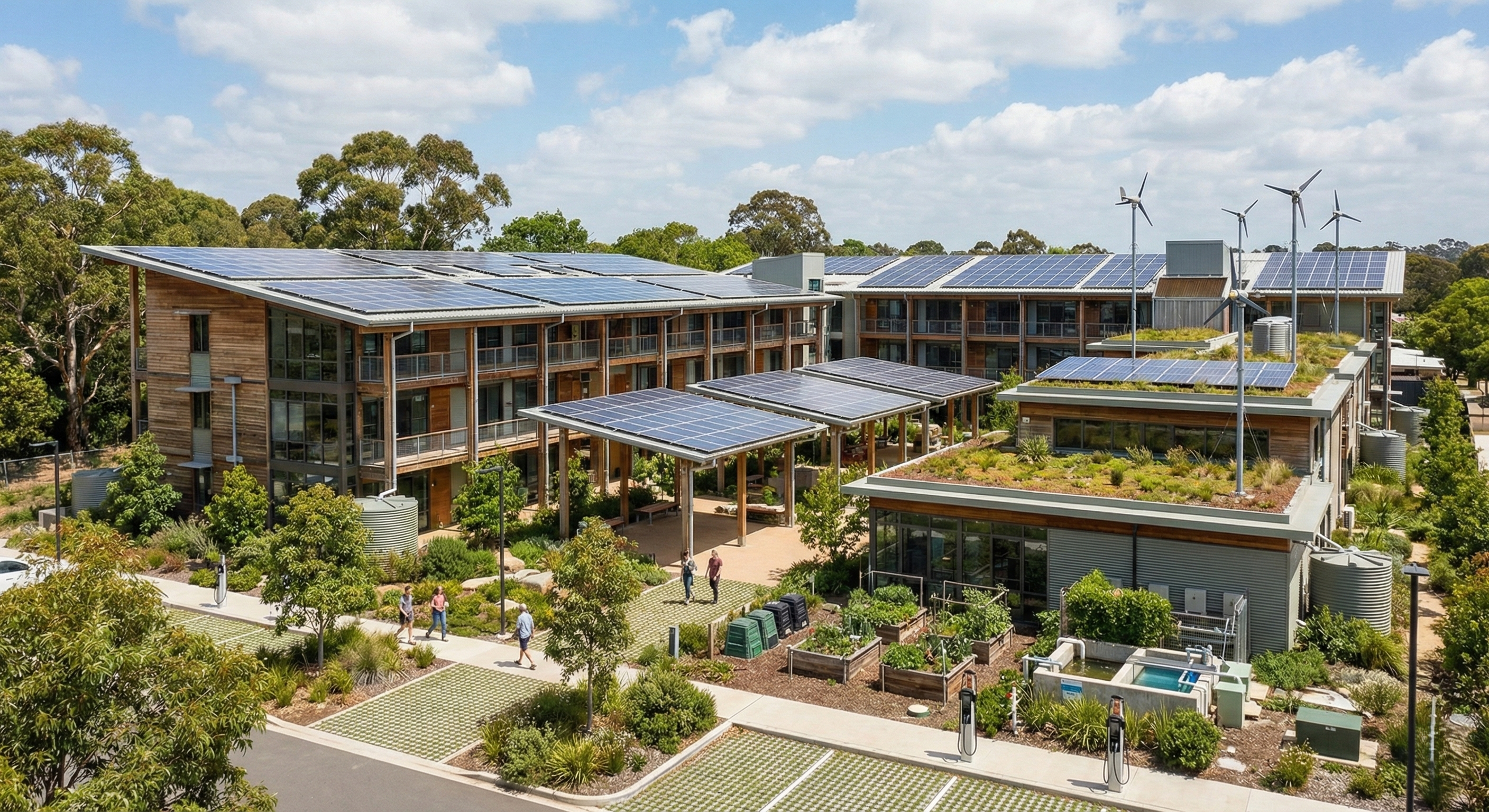
Beyond Energy: Why Triple Net Zero Buildings Are The New Standard
Triple net zero is one of those phrases that sounds simple-until a project team tries to write it into a sustainability narrative, a spec, or a press release. The challenge isn’t ambition.
It’s clarity:what exactly is being balanced, over what time period, and with what evidence?
This destination article treats triple net zero the way high-performing projects do in real life, as a design + operations accounting problem. Once the boundaries are explicit, the strategies become clearer, and the proof becomes publishable.
Key Takeaways: The Triple Net Zero Framework
- Definition:100% onsite neutrality for Energy, Water, and Waste annually.
- The Energy Pillar:Combines ultra-efficient envelopes with onsite renewables, PV, wind, or geothermal.
- The Water Pillar:Uses closed-loop systems to harvest, treat, and recycle all water onsite.
- The Waste Pillar:Diverts 100% of operational and construction waste through circular design and composting.
- Primary Driver:Modular construction is emerging as the gold standard for achieving these precision targets.
The Plain-English Definition Of Triple Net Zero
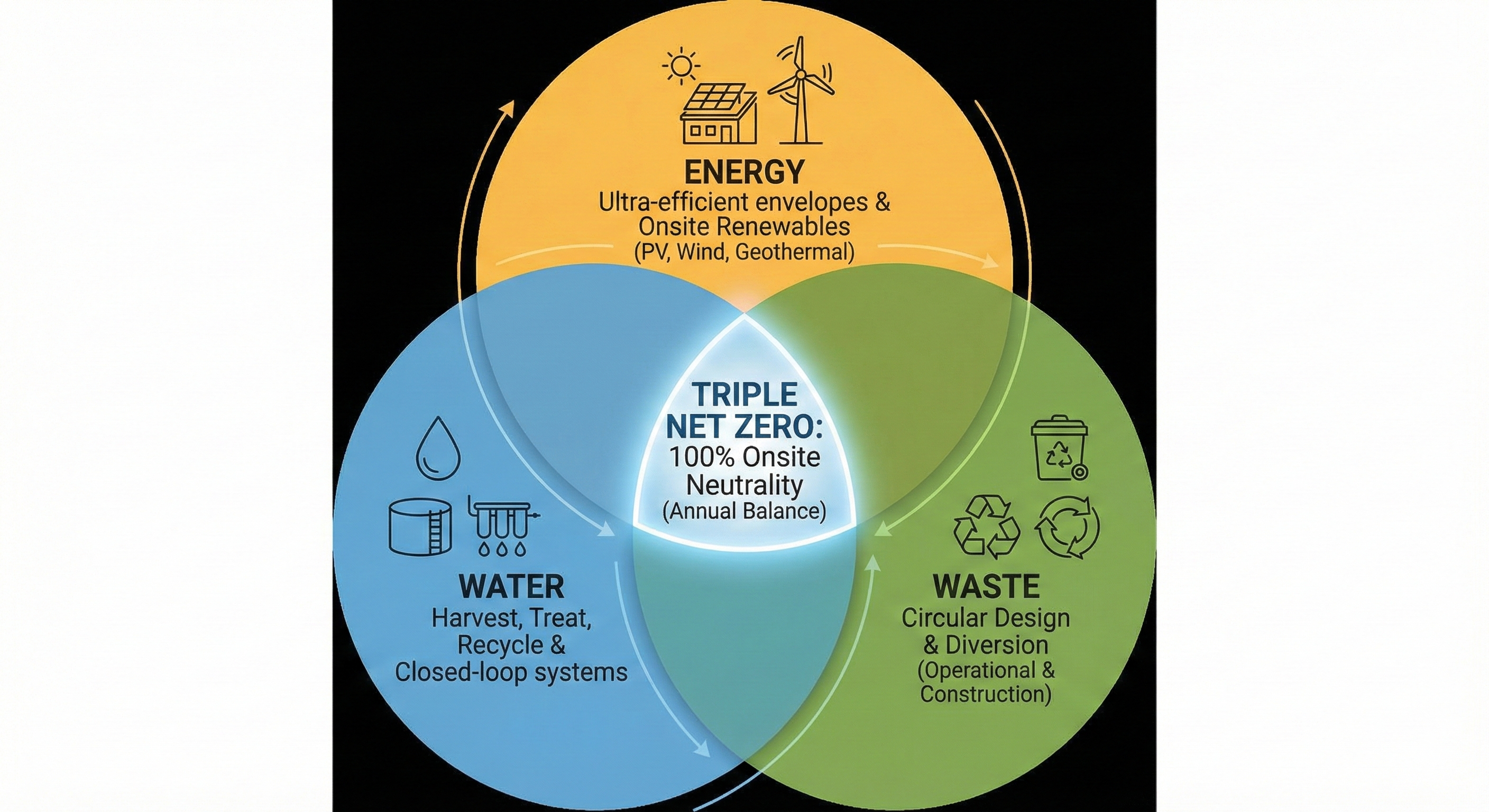
By the end of this section, you’ll be able to define triple net zero in one paragraph that holds up in a design review, a client meeting, or a public claim.
A triple net zero building aims to achieve net zero outcomes across three resource areas, most commonly:
- Energy net zero energy
- Water net zero water, often framed around potable water
- Waste net zero waste, often framed around landfill diversion
The Problem:triple net zero is often used as a goal statement, not a single universal standard. Some organisations formalise parts of it through programs like LEED Zero and TRUE; others use it as internal terminology.
The Most Common Definition: Energy, Water, Waste
If a project says triple net zero with no additional qualifiers, this is the safest assumption to test against.
- Energy:balance annual energy use with renewable energy supply
- Water:balance annual potable water demand with alternative supply or return-to-system logic
- Waste:reduce and divert solid waste so nothing or nearly nothing goes to landfill
Alternate Triple Definitions You’ll See In The Wild
Teams sometimes swap one pillar for another:
- Carbon instead of waste:net zero energy, net zero water, net zero carbon
- Operational carbon only vs whole-life carbon:operational, embodied
When this happens, the right move isn’t to argue the true definition-it’s to translate the claim into:
- A boundary statement:what’s included/excluded
- A measurement period:often 12 months
- A verification pathway:internal reporting, third-party program, or both
The Boundary Statement You Should Write Before You Design Anything
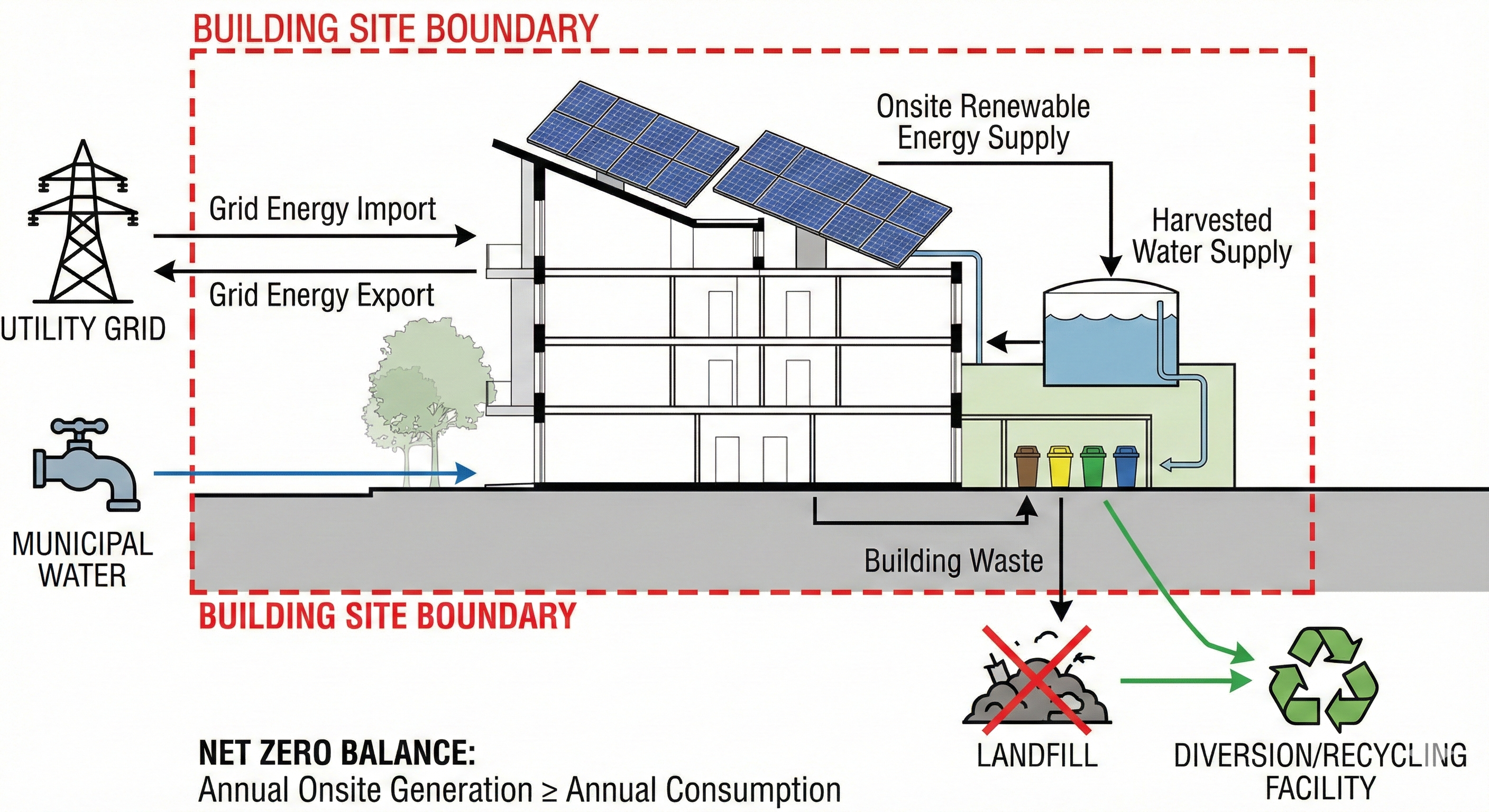
A triple-net-zero claim becomes credible the moment it becomes specific.
Boundary Statement Builder
This project targets triple net zero, defined as:
- Net zero energy is measured as an annual source energy balance across the building site boundary.
- Net zero water is measured as an annual potable water balance.
- Net zero waste is measured as an annual diversion rate aligned with a recognised zero-waste framework.
- The reporting period is 12 consecutive months of operational performance post-occupancy, supported by submetering and documented waste tracking.
Takeaway:A triple-net-zero aspiration becomes actionable once the boundaries are written, and that leads directly to the framework that keeps the whole effort coherent.
Net Zero Energy: Reduce First, Then Produce
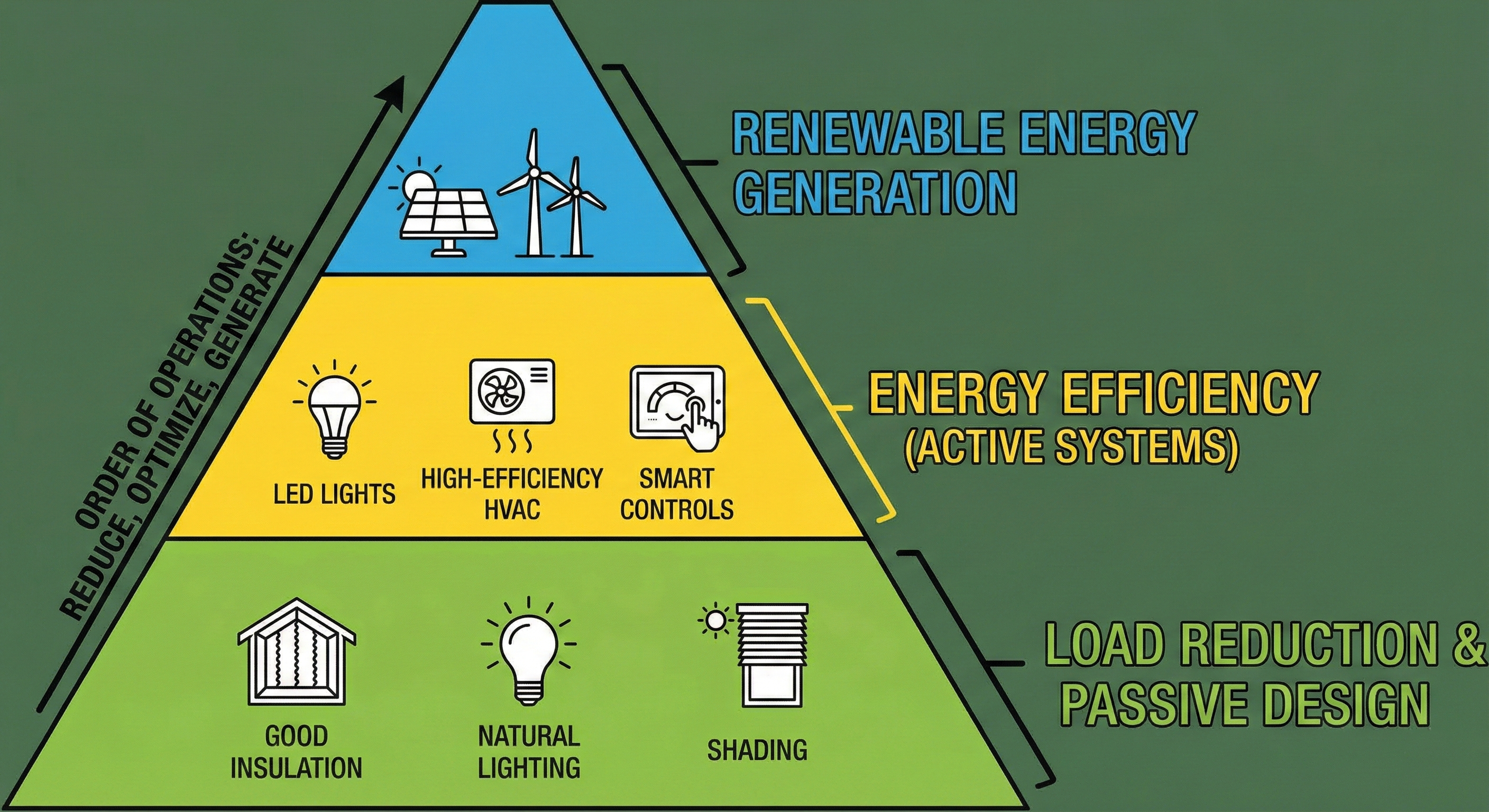
Here you’ll get the practical stack that teams use to make net-zero energy plausible before they ever talk about PV capacity.
Net zero energy is easiest to miss when a team starts with solar and treats efficiency as a nice-to-have. Credible definitions consistently require clear accounting and an annual balance.
Load Reduction
In an illustrative mid-rise office retrofit, the team’s biggest lever isn’t the inverter-it’s the envelope and load profile.
High-impact moves often include:
- Better insulation continuity and thermal-bridge control
- Smarter glazing ratios and shading strategy, especially on high-gain orientations
- Airtightness improvements that make ventilation and conditioning predictable
The design logic is simple:every watt you don’t need is a watt you don’t have to generate, and the roof area is finite.
Efficient All-electric System
A common modern pathway is full electrification with efficient equipment:
- High-efficiency heat pump systems
- Lighting power density discipline and controls that actually match use patterns
- Plug-load management as a design + operations conversation
Evaluation standards for zero net energy emphasise defining boundaries and measuring energy flows during operation, not treating MEP as an afterthought.
Renewables, Storage: Sizing Realities And Constraints
This is where reality checks pay off:
- Roof area and setbacks cap PV potential.
- Shading and orientation change yield.
- Storage can support resilience and peak shaving, but it doesn’t replace the demand-reduction work.
A useful way to keep the conversation honest is to treat renewables as the final capstone, the piece that closes the gap after demand is deeply reduced.
Takeaway:When energy demand is genuinely minimised, net zero energy becomes a solvable sizing problem, and that sets up the next, more locally constrained challenge: net zero water.
Net Zero Water: Cut Demand, Close Loops, And Respect Local Codes
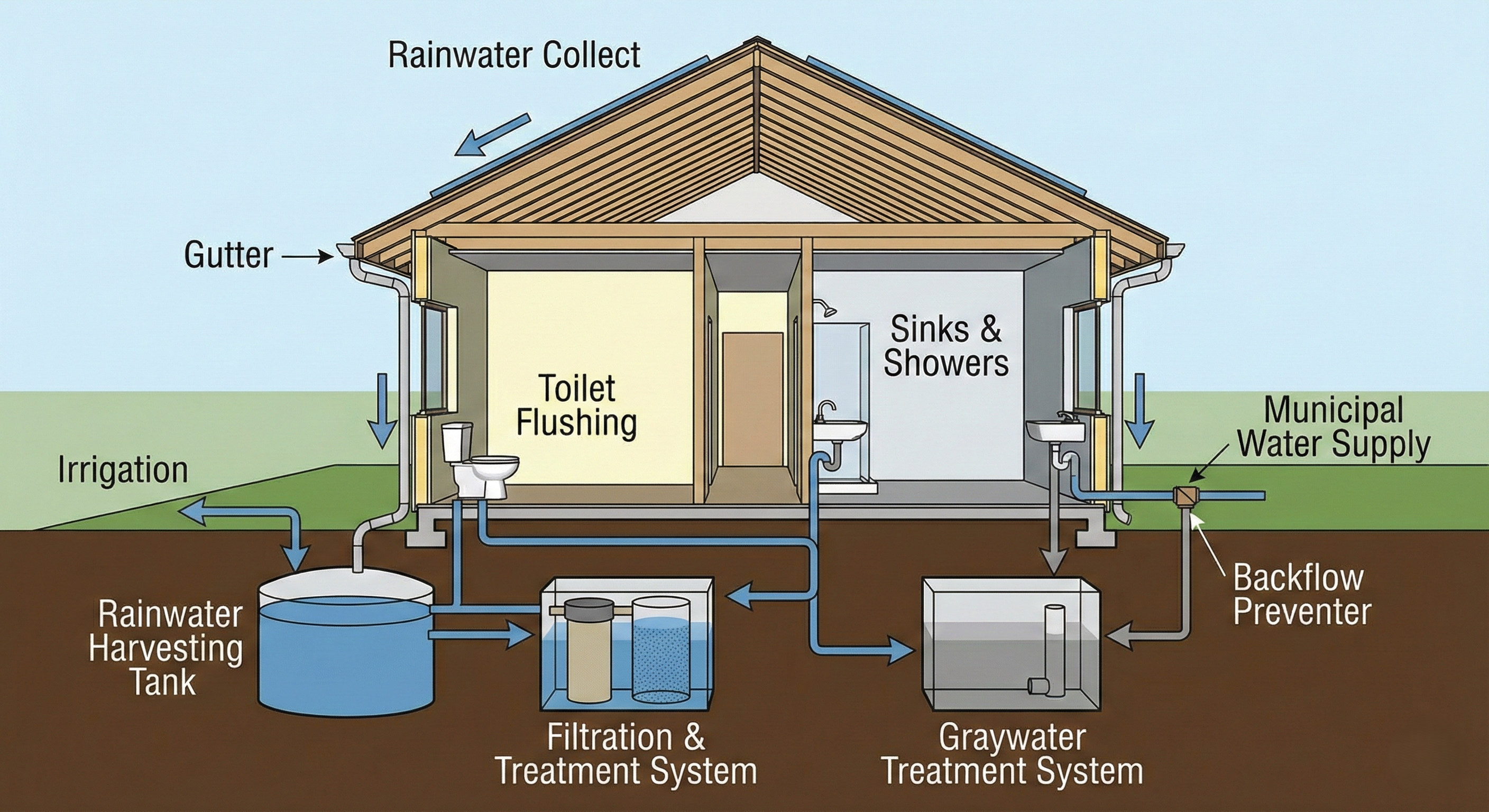
This section helps you plan net-zero water without hand-waving by separating demand reduction, alternative supply, and code reality.
Net zero water is less universal than net zero energy because water is deeply local; rainfall, rights, regulations, and public health rules vary. Frameworks like LEED Zero Watercommonly frame it as a potable water use balance of zero over 12 months.
Demand Reduction
A mixed-use project in a water-stressed region usually starts with:
- Ultra-efficient fixtures and realistic occupant assumptions
- Cooling tower strategy or alternatives where applicable
- Landscape that’s designed like a system, not decoration
Reducing potable demand makes every alternative water strategy smaller, cheaper, and easier to operate.
Alternative Water Supply
The U.S. Department of Energy frames alternative water as water sourced from sustainable supplies to reduce reliance on fresh surface and groundwater sources. Examples include harvested rainwater, captured condensate, reclaimed wastewater, process reuse, graywater, and desalinated water.
Practical design questions that matter early:
- How much capture is realistically available in the roof area, rainfall patterns, and HVAC condensatevolumes?
- What storage footprint is acceptable?
- What end uses are permitted: irrigation, flushing, and cooling tower makeup?
Treatment, Reuse Pathways
Water reuse is never just plumbing; it’s risk management:
- Source water quality varies by use.
- End-use quality needs drive treatment complexity.
- Operations and maintenance discipline becomes non-negotiable.
DOE implementation guidance emphasises assessing feasibility and implementing alternative water projects through structured evaluation steps, which mirrors how successful project teams plan these systems.
Net Zero Waste: Design Out Waste Before You Manage It
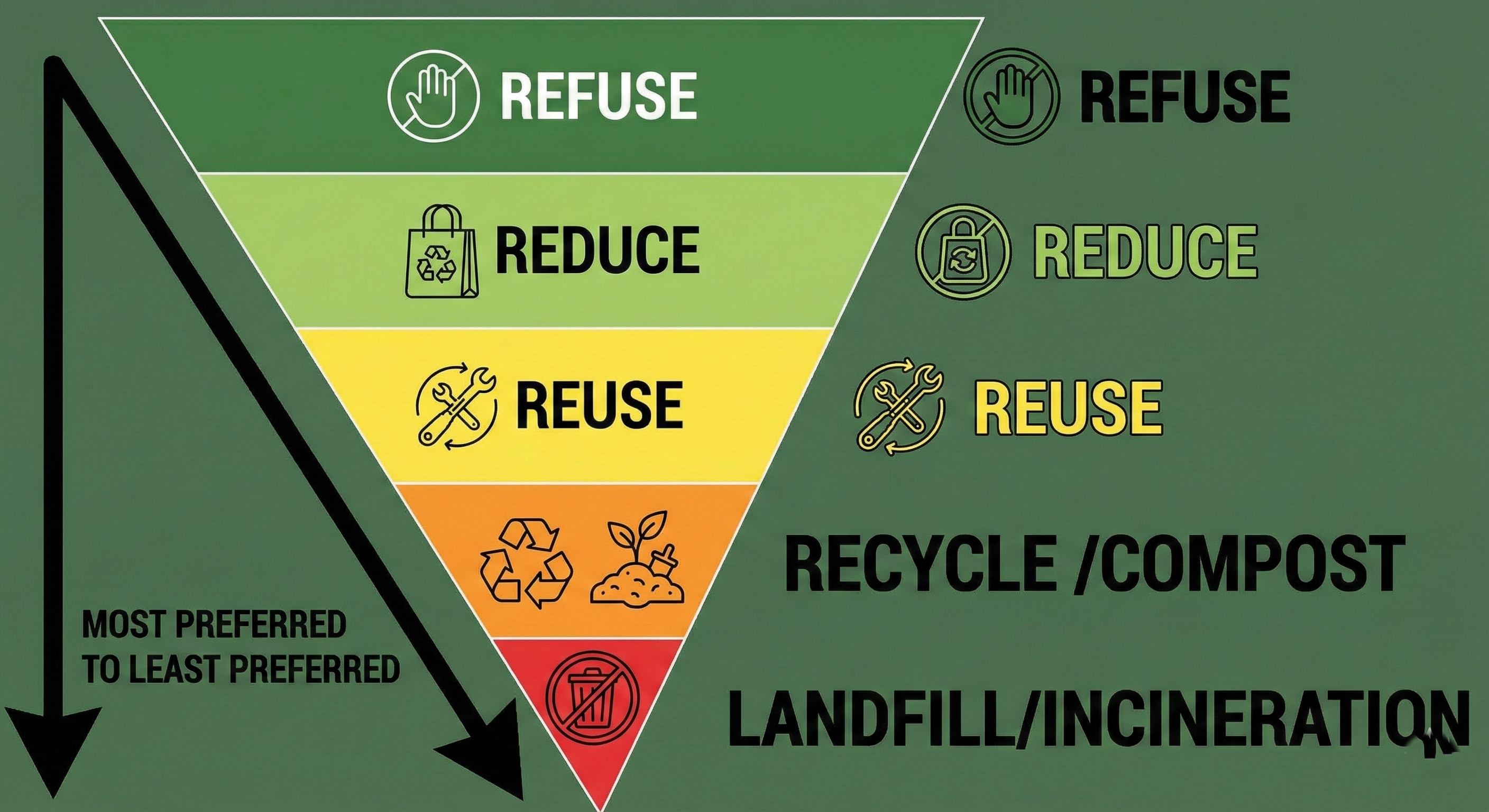
Waste is where many triple net zero claims quietly lose trust. That’s why recognised zero-waste certification systems include strict minimum program requirements and annual data expectations.
For example, GBCI’s TRUE program requires, among other minimum requirements, a zero waste policy and an average of ≥90% diversion from landfill, incineration, including waste-to-energy, and the environment for solid, non-hazardous wastes over the most recent 12 months.
Construction Waste Vs Operational Waste
A project team should treat waste as two different problems with different levers:
- Construction waste:procurement, packaging, jobsite sorting, take-back programs
- Operational waste:tenant behaviour, hauling contracts, contamination control, education
Mixing them into one claim is where accountability gets fuzzy.
Diversion, Contamination, And Procurement
High diversion numbers can be meaningless if contamination is unmanaged. Practical controls include:
- Clear material streams and bin design
- Vendor alignment:what they actually accept, and where it goes
- Feedback loops:contamination audits and signage updates
TRUE’s framing of diversion and program requirements helps teams avoid marketing math that collapses in operation.
The Operations Playbook
In an illustrative multi-tenant building, the waste program holds together when:
- The bin layout matches the way people actually move
- Signage uses plain language and consistent iconography
- Contracts and vendors are set up for the streams you promise
- Someone owns the monthly review, not just the launch event
Takeaway:Net zero waste is operationally intensive by nature-so the next step is integrating energy, water, and waste so one zero doesn’t sabotage another.
The Synergy Effect: How The Pillars Interact
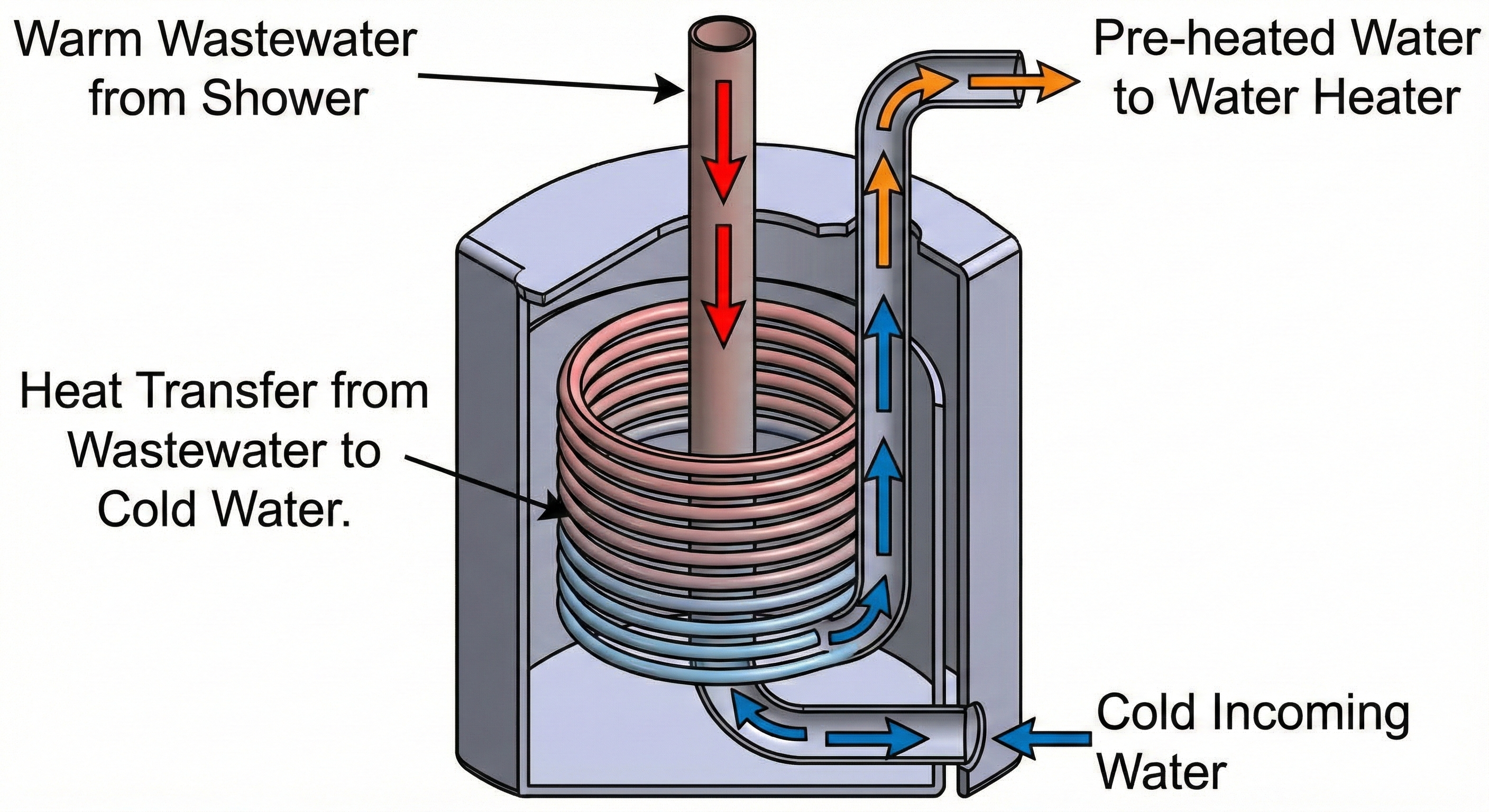
In my design practice, I’ve found that the three pillars are not silos; they are interconnected systems. Success in one often leads to success in another.
Why Water Management Is An Energy Strategy
A common mistake is viewing water and energy as separate budgets. However, moving and heating water is energy-intensive.
By treating water onsite and utilising heat exchangers on drain lines, we can recover thermal energy from warm shower water to pre-heat the incoming supply.
This synergy reduces the total PV array size needed to reach the energy pillar.
The Role Of Embodied Carbon In Waste Neutrality
The Waste Pillar forces us to look at Embodied Carbon, the emissions generated during the manufacturing and transport of materials.
By selecting carbon-sequestering materials like mass timber, we satisfy the waste requirement of end-of-life circularity while simultaneously lowering the building's total carbon footprint before the first light switch is even flipped.
The Modular Advantage: AORA And The Future Of Scaling
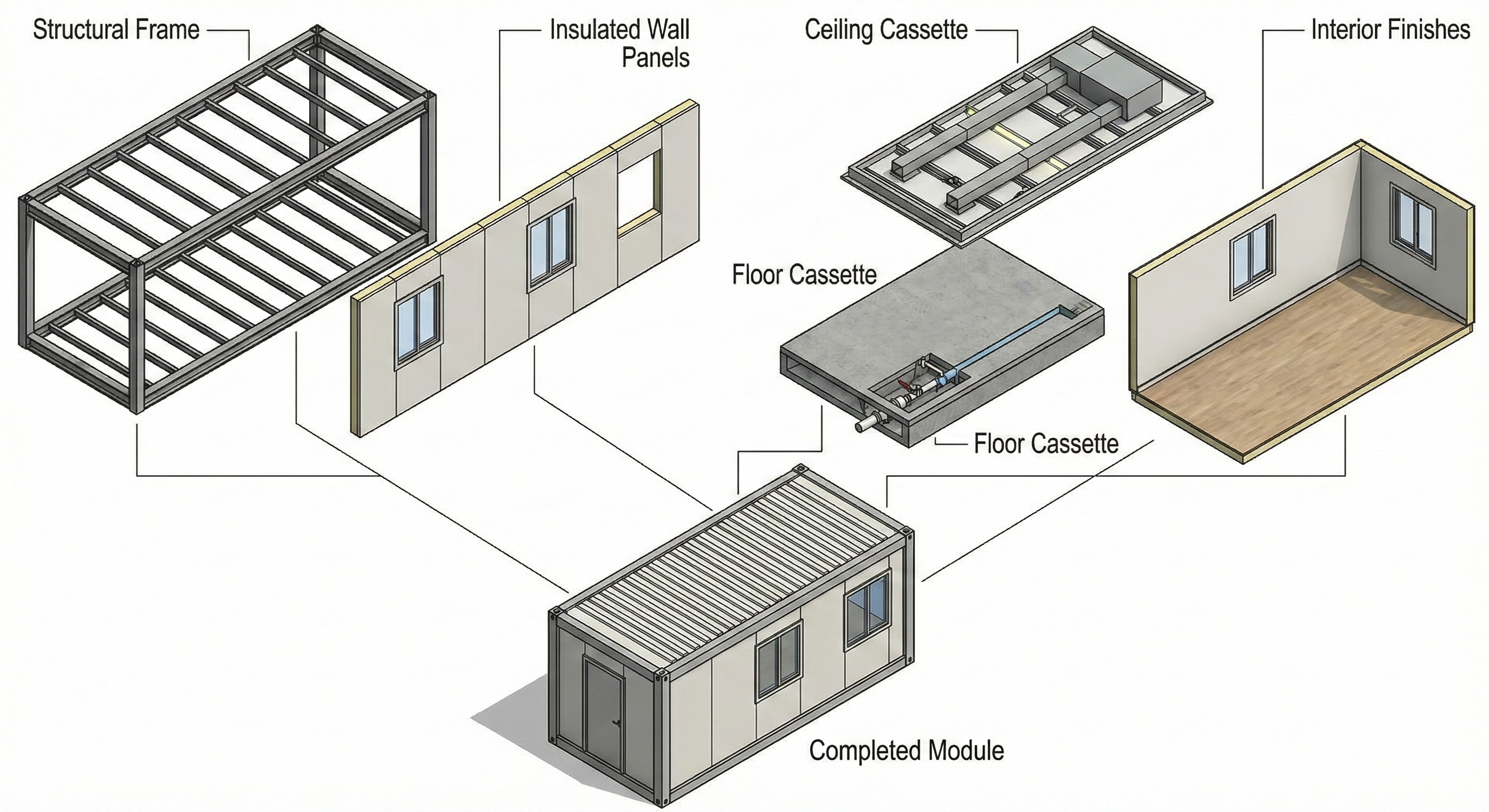
Achieving the precision required for Triple Net Zero is difficult with traditional stick-built construction. This is where modular methods are changing the game.
Precision Engineering For Airtight Envelopes
Triple Net Zero depends on an airtight building envelope. In a controlled factory environment, modules are built with tolerances of mere millimetres.
This level of precision is nearly impossible to replicate on a windy, muddy construction site. Projects like the AORA development in New York are proving that modular units can be pre-fitted with integrated solar and water recycling tech before they even arrive on-site.
Reducing Onsite Construction Waste By 90%
Traditional construction sites are notorious for waste. Modular construction, however, operates on a just-in-time manufacturing model.
Materials are cut to exact specifications in the factory, and any off-cuts are immediately recycled. This allows a project to meet the Construction Waste requirement of the Triple Net Zero standard with far less effort.
Certifications And Standards That Can Validate Your Triple Net Zero Claim
Here you’ll get a clean map of credible third-party frameworks that can support or challenge a triple net zero story.
Triple net zero itself may be a goal phrase, but parts of it can be validated through recognised programs.
LEED Zero Energy, Water, Waste And Its 12-month Logic
USGBC’s LEED Zero program includes:
- LEED Zero Energy:recognises a source energy use balance of zero over 12 months
- LEED Zero Water:recognises a potable water use balance of zero over 12 months
- LEED Zero Waste:recognises projects that achieve GBCI TRUE certification at Platinum
That structure matters because it makes net zero a measurable operational outcome rather than a design aspiration.
TRUE Zero Waste
GBCI’s TRUE minimum program requirements include a policy foundation and the operational reality of maintaining ≥90% diversion over 12 months with a defined approach to what counts as diversion.
For teams, TRUE is useful even when not pursued formally because it forces the questions that otherwise get skipped: contamination, vendor realities, and annual reporting discipline.
Where Net Zero Carbon Fits
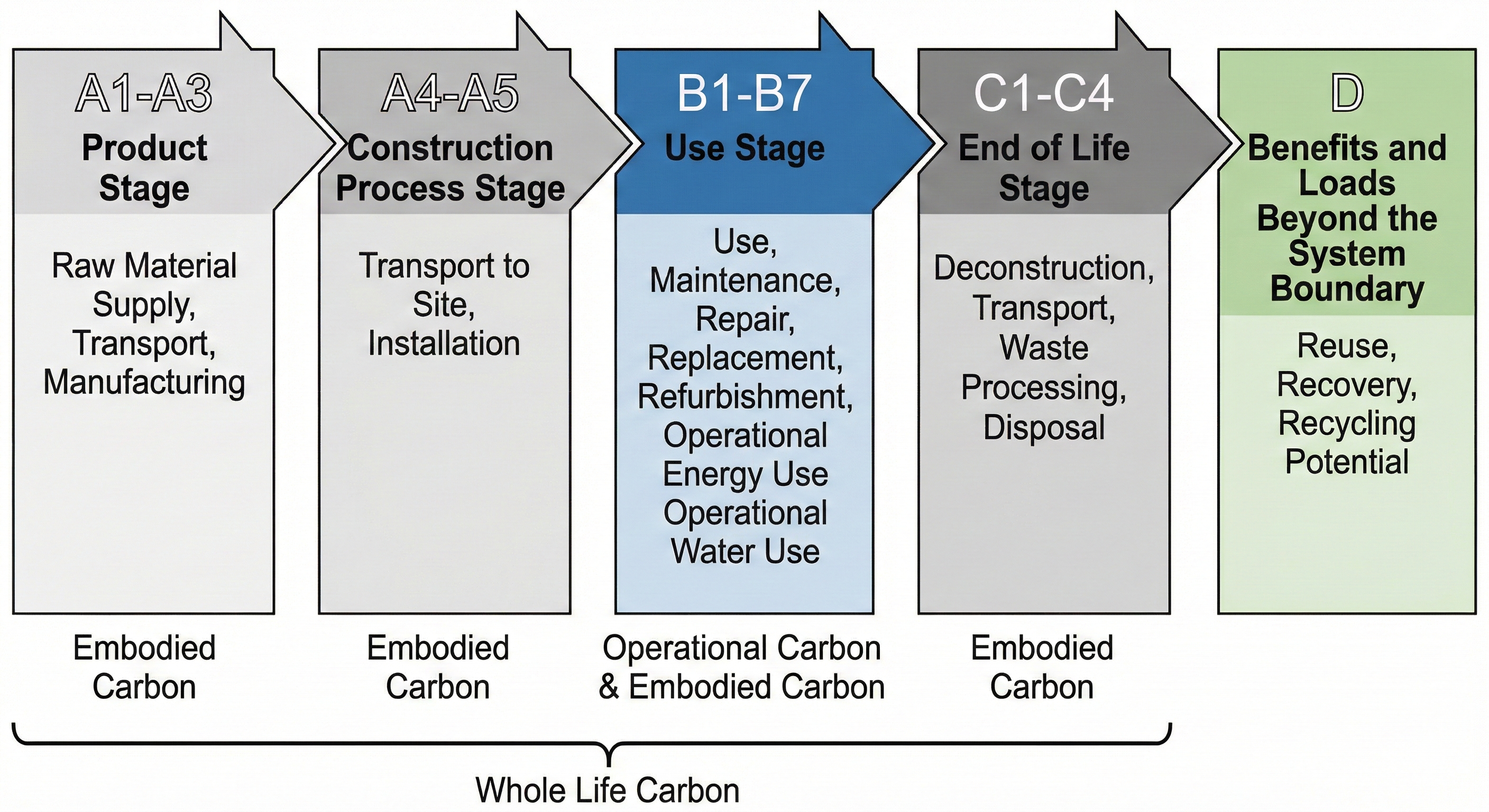
Many readers encounter net zero through carbon language. WorldGBC notes that truly decarbonised buildings require a whole-life carbon approach, addressing operational energy emissions and embodied carbon from materials and construction.
This is why a triple net zero claim can still feel incomplete if it ignores carbon boundaries, especially embodied carbon, even when energy, water, and waste performance is strong.
Takeaway:Standards help, but proof still depends on what gets measured and published, so the next section focuses on the practical documentation package that makes claims trustworthy.
A Worked Illustrative Scenario: One Project Team, Three Balances, Real Constraints
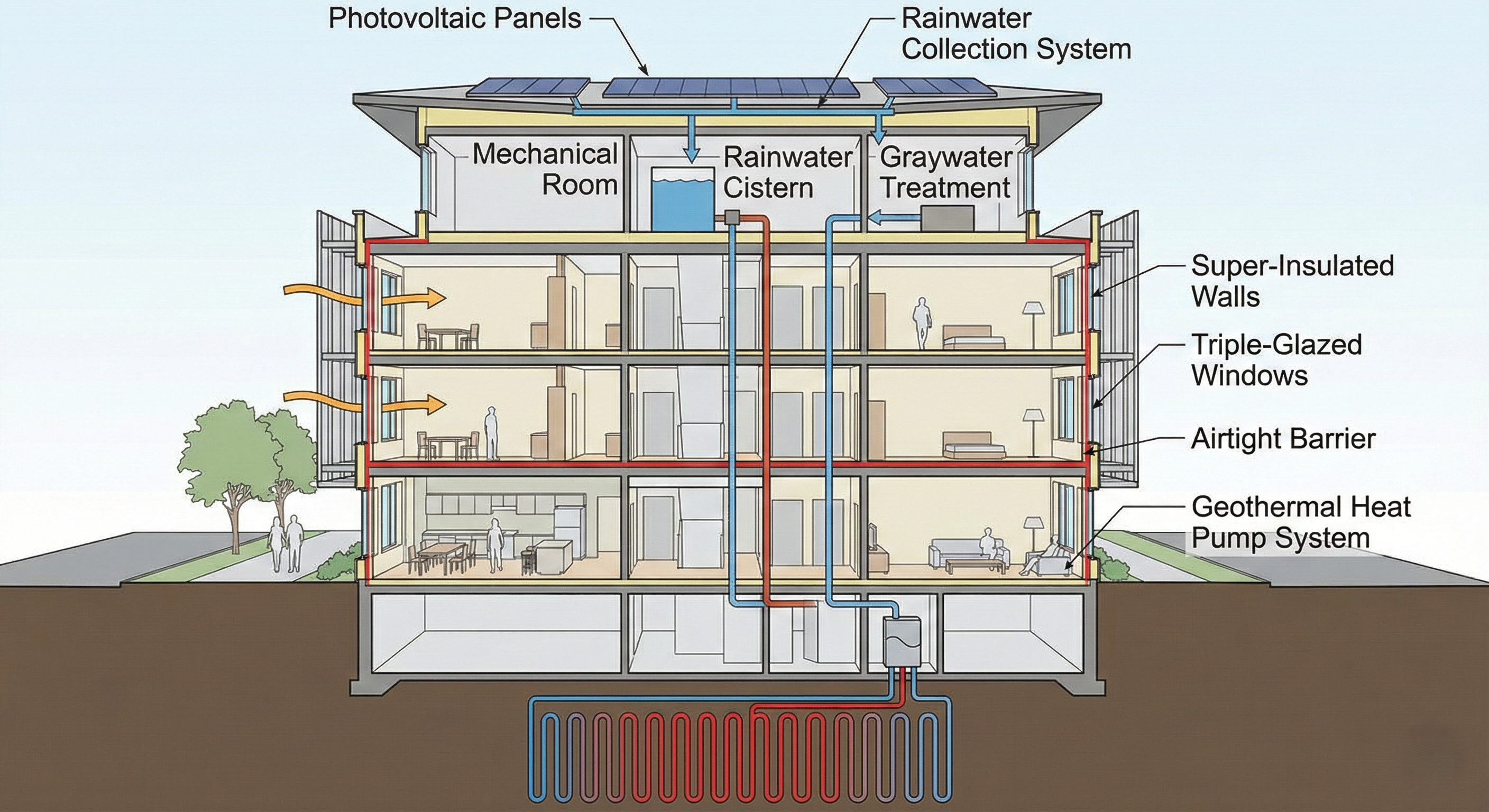
This scenario translates theory into decision-making, showing how triple net zero becomes a coordinated design and operations plan.
Scenario Setup
A project team is designing a six-story mixed-use building:retail at grade, offices above. The city encourages sustainability claims, but water reuse is tightly regulated, and the roof has limited area due to mechanical screens and setback rules.
The owner wants triple net zero, but the team insists on starting with the boundary statement: energy and water will be tracked as 12-month operational balances, and waste will align with a recognised diversion framework rather than a vague zero landfill slogan.
Strategy Stack
Energy stack:
- Envelope and glazing are tuned to cut peak loads.
- HVAC is electrified and designed for stable controls.
- PV is sized after load reduction, accepting that roof area limits generation; procurement options are documented transparently.
Water stack:
- Fixtures and process loads are aggressively reduced.
- Condensate capture is added because it’s predictable for this occupancy pattern.
- A limited rainwater system supports non-potable uses permitted by code, using DOE-style alternative water framing and a stepwise feasibility approach.
Waste stack:
- Construction specs include packaging reduction and waste sorting requirements.
- Operations planning includes bin design, tenant onboarding, and vendor alignment to protect diversion performance over time.
- The team uses TRUE-style minimum requirements as a program backbone to avoid claims that can’t be maintained.
What They Publish As Proof
After occupancy, the team publishes a simple dashboard-style report:
- The boundary statement
- Monthly energy, water, and waste totals
- A one-page explanation of anomalies and program changes
They don’t claim net zero water unless the potable balance is actually achieved over the defined period. They report progress transparently instead, because credibility lasts longer than a label.
Takeaway:The scenario’s lesson is simple, triple net zero is achievable only when teams keep the definition, metrics, and proof aligned, so the final step is answering the questions stakeholders ask most.
Global Benchmarks: The 2026 Triple Net Zero Landscape
Snapshot:The project statuses and performance claims below are based on publicly available sources and may evolve as new data is published.
As of February 2026, triple net zero is still an umbrella term, but a clearer pattern is emerging, the most credible case studies publish defined boundaries and measurable performance claims, especially around operational energy.
In Europe, several triple-zero references focus on eliminating purchased energy for specific end uses, often heating, cooling, and ventilation.
In North America, some in-progress developments are publicly targeting triple net zero outcomes while emphasising delivery methods such as modular/offsite fabrication as part of the strategy.
Vertikal Nydalen: Norway’s Triple Zero Success Story
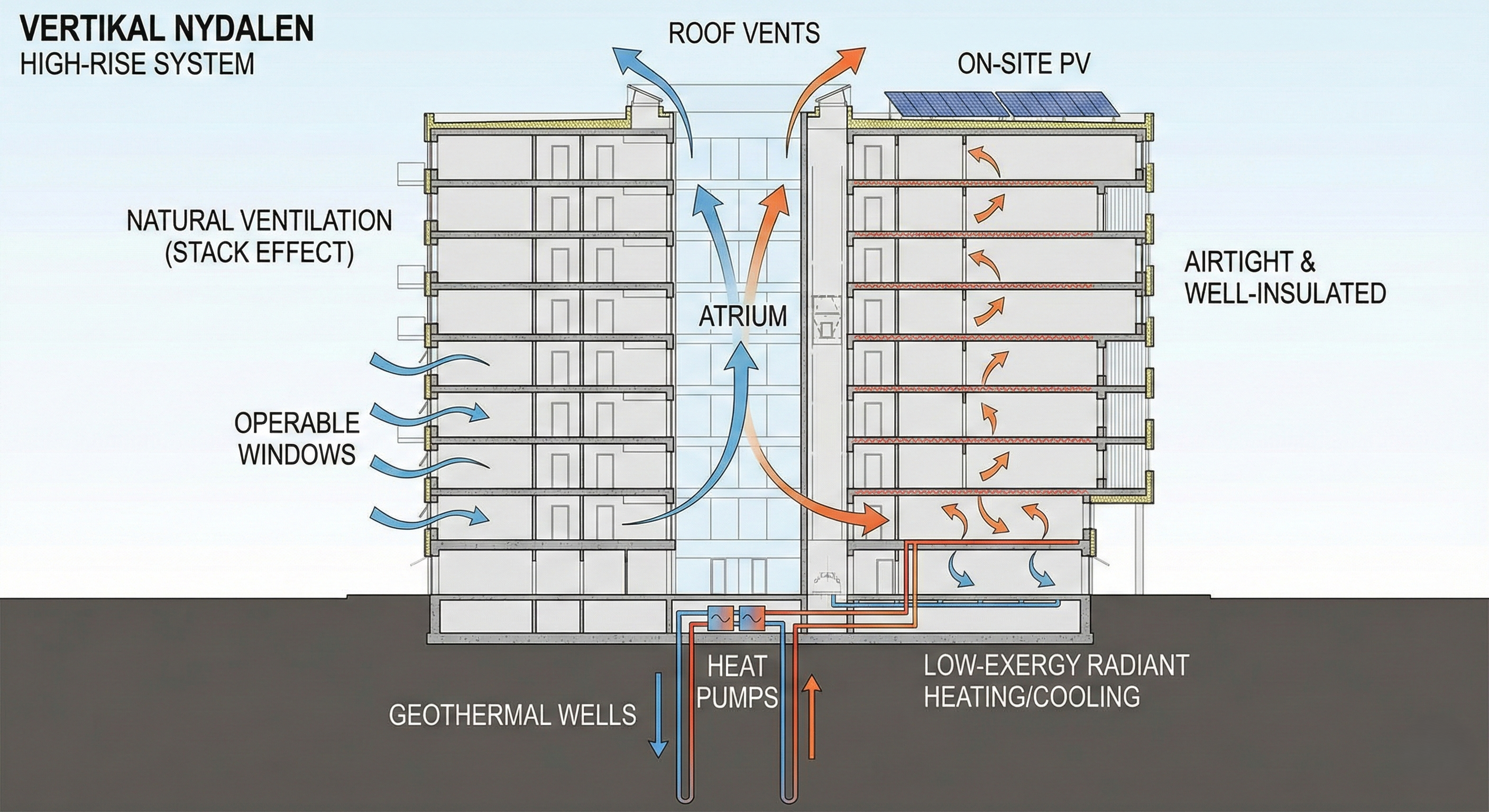
Vertikal Nydalen Oslois presented by Snøhetta as a triple zero solution project, specifically meaning no purchased energy for heating, cooling, or ventilation in both office and residential areas.
The concept relies on a simplified climate approach that combines geothermal wells, PV, a low-exergy heating/cooling system, and natural ventilation, reducing reliance on conventional duct-heavy solutions.
In 2024, the project was awarded Storebrand Eiendom’s Sustainability Award, which frames the building as an example of ambitious sustainability work in the real estate sector.
The AORA Project: New York’s Frontier Of Modular Autonomy
In the U.S., AoRa Development and the Modular Building Institute have described an in-progress project in Mount Vernon, NY, AoRa Centre, as targeting zero energy, zero water, and zero waste outcomes-often framed by the team as triple net zero.
Public-facing materials position modular/offsite methods as part of the delivery strategy, with the argument that factory conditions can improve coordination and reduce certain forms of jobsite waste, though the ultimate test will be transparent boundaries and measured performance reporting post-occupancy.
Benchmark Note:Different projects use triple zero/net zero to mean different scopes. In this article, treat benchmarks as evidence of an approach unless they publish boundaries and 12-month performance data.
Also Check Out:How To Design A Net-Zero Energy Commercial Building
Frequently Asked Questions (FAQ)
What Are Triple Net Zero Buildings?
Triple net zero buildings aim for net zero outcomes across three resource areas-most often energy, water, and waste-using defined boundaries and measurable performance.
Is Triple Net Zero A Formal Certification?
Not always. Teams often validate parts of the claim through programs like LEED Zero energy, water, waste and TRUE waste, supported by operational data.
What Does Net Zero Energy Mean In Practice?
It generally means the building balances annual energy needs with a renewable, zero-emission energy supply, using a stated accounting method and measured performance.
What Does Net Zero Water Mean?
A common framing is an annual potable water balance of zero, achieved through demand reduction and alternative supplies, then demonstrated with operational data.
What Does Net Zero Waste Mean?
It means preventing waste and diverting solid waste so that none or nearly none goes to landfill over a year, supported by documented diversion methods.
How Do You Prove Net Zero Energy, Water, And Waste?
State boundaries, then provide 12 months of operational totals plus documentation for renewables, alternative water systems, and waste diversion methodology.
What’s The Difference Between Net Zero Energy And Net Zero Carbon?
Net zero energy balances energy; net zero carbon addresses emissions and often calls for a whole-life approach, including operational and embodied carbon.
Can Urban Buildings Realistically Achieve Net-Zero Water?
Sometimes, but it depends on rainfall, roof area, code allowances, and treatment feasibility. Many urban projects target a deep reduction, plus a limited alternative supply instead.
What Are The Biggest Design Levers For Triple Net Zero?
Reduce demand first, envelope, systems, fixtures, waste prevention, then size renewables and alternative water systems, and design operations programs that sustain performance.
What Counts As Waste In Net-zero Waste Claims?
Credible approaches define whether the scope includes construction waste, operational waste, or both-and document diversion definitions, vendors, and contamination controls.
Does Zero Waste Require 100% Diversion?
Typically no. Recognised frameworks often set very high diversion requirements commonly ≥90% over 12 months alongside strict program rules and reporting.
Are Off-site Renewables Or RECs Allowed?
Some definitions and programs allow off-site renewable procurement under defined accounting, but it must be transparent and consistent with the chosen standard.
What Are Common Pitfalls That Cause Net Zero To Fail In Operation?
Insufficient metering, weak commissioning, controls overrides, plug-load growth, and waste programs that degrade through contamination or tenant turnover.
What’s A Realistic Roadmap From Concept To Verified Performance?
Define boundaries model and design the reduction stack, install metering and commission systems, operate for 12 months, report and verify results.
Where Can I Find Credible Examples Of Triple Net Zero Projects?
Prioritise projects that publish boundaries and 12-month performance evidence or align with third-party verification pathways like LEED Zero and TRUE.
Final Words
Triple Net Zero is not just a certification; it is a philosophy of autonomy. By designing buildings that provide their own power, water, and waste management, we create structures that are assets to their environment rather than drains on it.
As architects, our goal is to design spaces that don't just sit on the land, but breathe with it. The technology exists-it is now a matter of vision to implement it.
Jump to
Beyond Energy: Why Triple Net Zero Buildings Are The New Standard
The Plain-English Definition Of Triple Net Zero
Net Zero Energy: Reduce First, Then Produce
Net Zero Water: Cut Demand, Close Loops, And Respect Local Codes
Net Zero Waste: Design Out Waste Before You Manage It
The Synergy Effect: How The Pillars Interact
The Modular Advantage: AORA And The Future Of Scaling
Certifications And Standards That Can Validate Your Triple Net Zero Claim
A Worked Illustrative Scenario: One Project Team, Three Balances, Real Constraints
Global Benchmarks: The 2026 Triple Net Zero Landscape
Frequently Asked Questions (FAQ)
Final Words

George Evans
Author
George Anderson, an exceptional architectural designer, envisions and brings to life structures that transcend the realm of imagination. With an unwavering passion for design and an innate eye for detail, George seamlessly blends form and function, creating immersive spaces that inspire awe.
Driven by a deep appreciation for the interplay of space, light, and materials, George's innovative approach redefines the possibilities of architectural design. His visionary compositions leave an indelible mark, evoking a sense of wonder and transforming the built environment.
George Anderson's transformative designs and unwavering dedication continue to shape the architectural landscape, pushing the boundaries of what is possible and inspiring generations to come.
Latest Articles
Popular Articles