What Is Mass Timber Construction - When It Beats Steel Or Concrete
What is mass timber construction? Unpack the engineering, types (CLT vs Glulam), and sustainability benefits of this modern building method.
Author:George EvansApr 22, 20262.7K Shares180.9K Views
Engineering Nature: What Is Mass Timber Construction And Why Is It Taking Over?
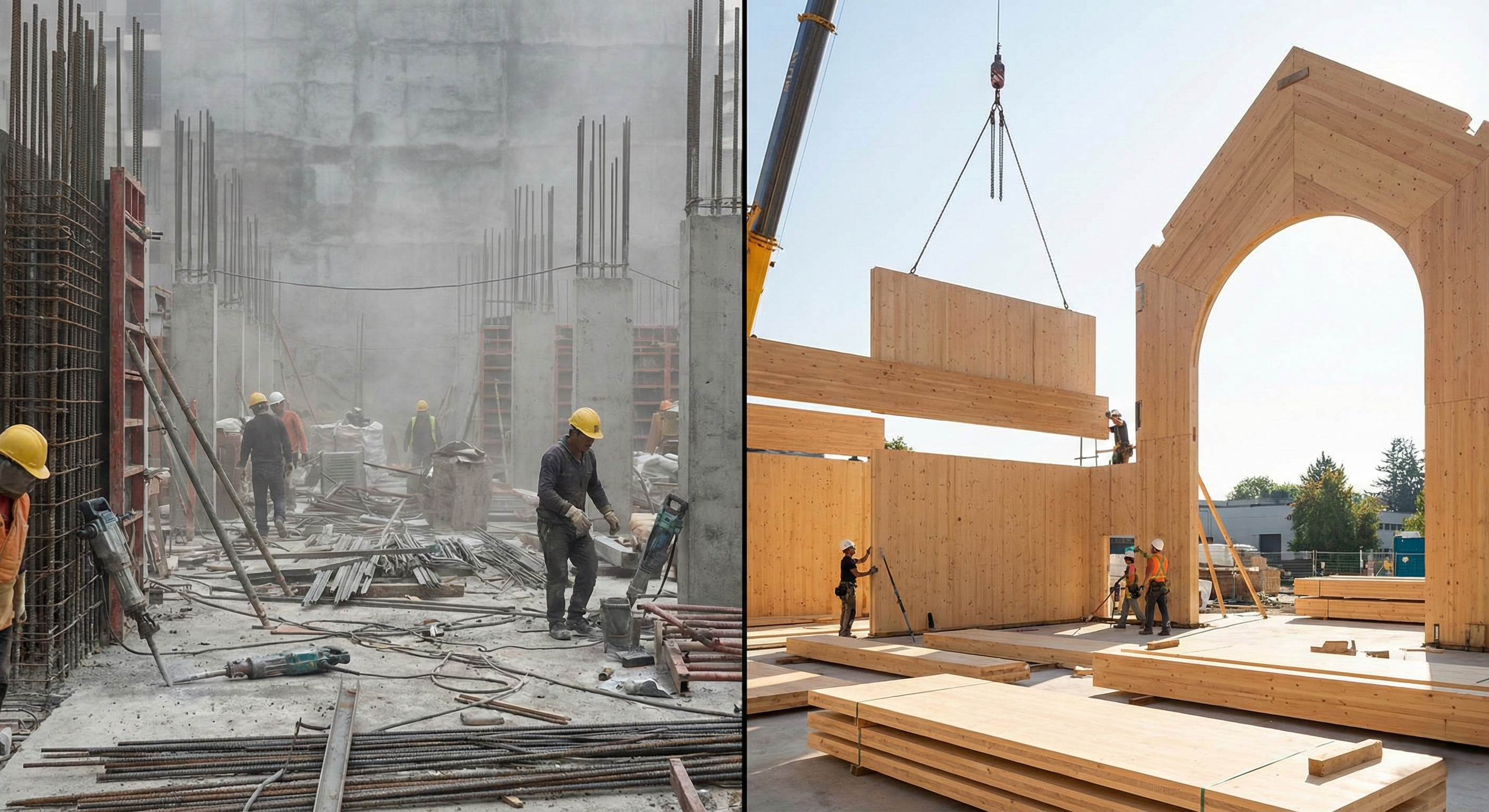
Walk onto a traditional construction site, and your senses are assaulted. The air is thick with silica dust; the noise of jackhammers and grinding metal is deafening. It is a chaotic, gray environment.
Now, step onto a mass timber site. The difference is jarring in the best possible way. The air smells of pine and spruce.
The noise level is dramatically lower, dominated by the hum of electric cranes and the rhythmic thud of mallets rather than the screech of grinders. It feels less like a construction zone and more like a precise assembly lab.
This is the world of Mass Timber Construction, a building methodology that is not merely a return to wood, but a leap forward into high-performance engineering.
It is where the ancient warmth of timber meets the cutting-edge precision of modern manufacturing, creating structures that are lighter, faster to build, and arguably more human than anything we have built in the last century.
Key Takeaways:
- What is it?A construction method using large, solid engineered wood panels and beams like CLT and Glulam for load-bearing structures.
- Key Benefit:Offers the structural strength of steel and concrete but weighs approximately 20% as much.
- Sustainability:Sequesters carbon dioxide within the building fabric rather than emitting it during production.
- Speed:Components are prefabricated off-site to millimeter precision, allowing for 25% faster on-site assembly.
- Safety:Large timber sections are inherently fire-resistant due to charring, which insulates the structural core.
The One-Sentence Definition
Mass timber construction is building with large, engineered wood structural components-panels, beams, and columns manufactured with precision and assembled as the building’s primary structural system.
Takeaway to carry forward:once you see mass timber as a system, not a vibe, the benefits and limitations become much easier to judge.
Mass Timber Vs Light-frame Wood
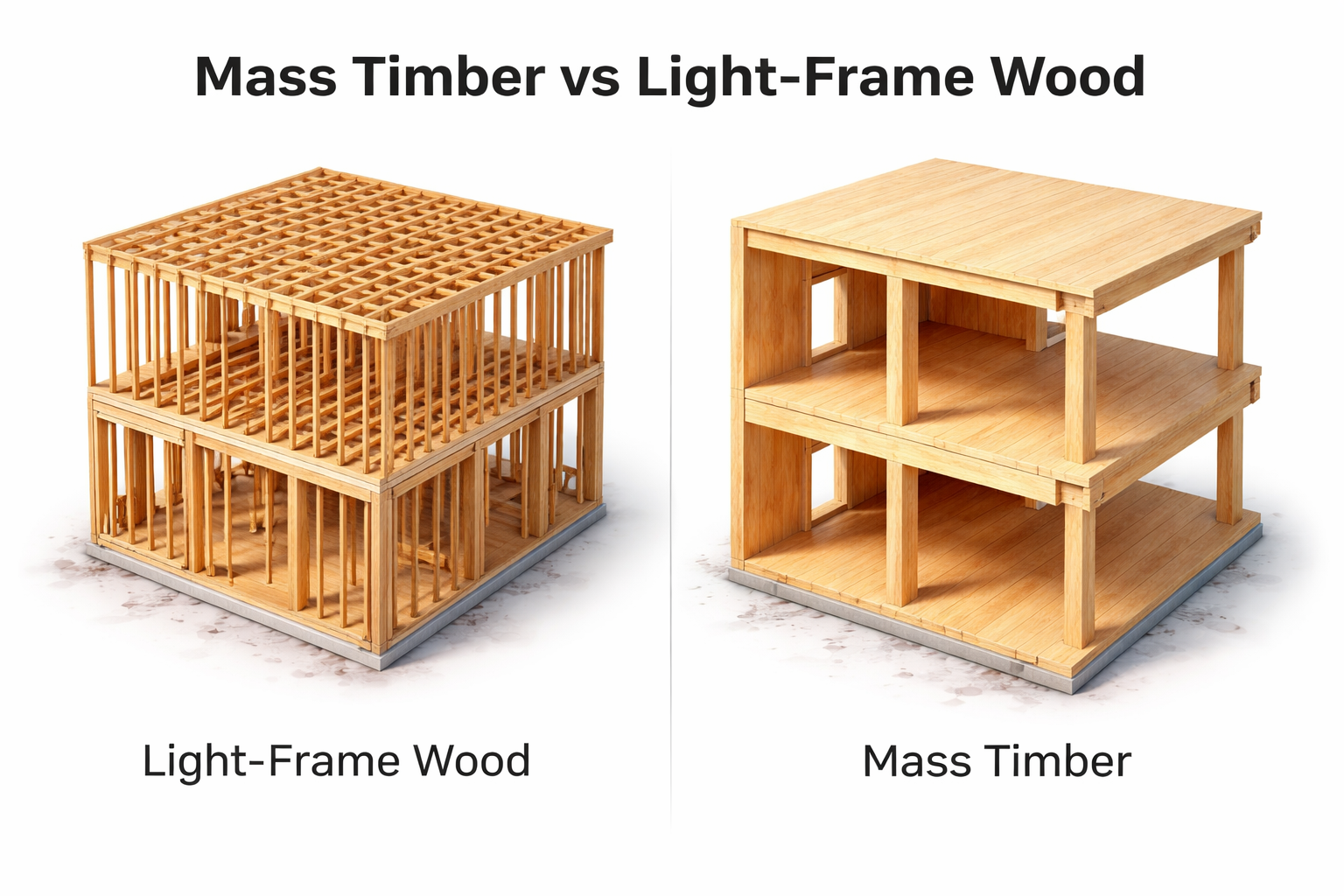
Light-frame construction, the typical stick-built approach, relies on many small members - studs, joists, rafters repeating at close spacing. Mass timber construction uses fewer, larger structural elements that do more work per piece.
That difference matters because it affects:
- Coordination:fewer pieces, but each piece is more final, so coordination happens earlier.
- Erection:a crane and an installation sequence often replace long stretches of on-site framing.
- Performance detailing:acoustics, vibration, fire strategy, and connections become first-order design decisions.
Takeaway:The next common confusion is mixing up mass timber with timber frame and heavy timber, so let’s separate those cleanly.
The Mass Timber Family CLT, Glulam, NLT, DLT, And Beyond
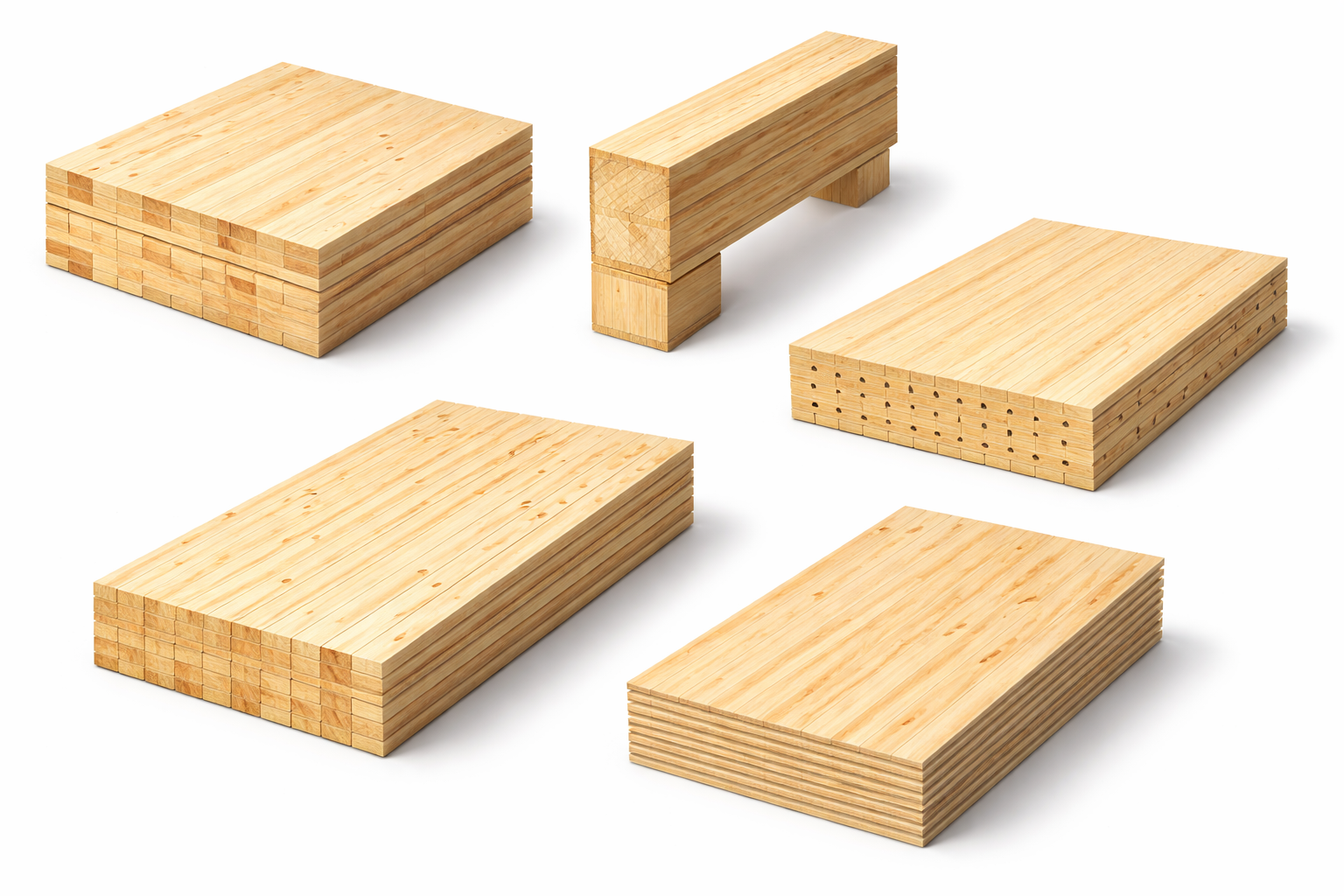
Mass timber isn’t one product-it’s a set of products you combine into a structural strategy. In this section, you’ll learn what each major product is and where it tends to make sense, so you can stop treating them like one interchangeable material.
CLT: Panels For Floors, Roofs, And Walls
Cross-laminated timber CLT is made by stacking lumber layers at alternating directions and bonding them into thick panels.
The result is a stiff, dimensionally stable structural plate that can be used for floors, roofs, and walls.
If you want a standards-based reference point, theANSI/APA PRG 320 standard for CLTis the key North American performance and qualification document.
Glulam: Beams And Columns, And Why It Pairs Well With CLT
Glulam glue-laminated timber is built from lumber laminations bonded together to form strong, predictable beams and columns.
It’s commonly paired with CLT: glulam frames carry loads; CLT spans between them as floor and roof plates.
NLT And DLT: Solid-Lumber Panel Systems
Nail - laminated timber NLT and dowel - laminated timber DLT are panel systems made from dimensional lumber stacked on edge and fastened together - NLT with nails/screws, DLT with hardwood dowels.
They’re often used for floors and roofs where a solid-wood panel aesthetic is desired and where the structural concept fits.
MPP/SCL: Where Mass Timber Overlaps With Other Engineered Systems
Some discussions include products like mass plywood panels MPP or other structural composite lumber SCL systems in the broader conversation, because they share the theme of large engineered wood elements.
The practical point: not every engineered wood product is mass timber in the same way, and code/acceptance can differ by product and jurisdiction.
A Simple 2-column Cheat Sheet Structured Element
| Product | Typical role in a building |
| CLT | Floor/roof/wall panels; diaphragm and plate behavior |
| Glulam | Beams and columns; primary frame lines |
| NLT | Floor/roof panels; often exposed decking aesthetic |
| DLT | Floor/roof panels; exposed aesthetic without metal fasteners in the face |
| Other engineered panels, e.g., MPP | Varies by system; often floors/roofs in specific markets |
Takeaway:Knowing the products is only half the story-mass timber changes when decisions happen because so much is prefabricated.
Timber-Concrete Composite TCC Floor Systems
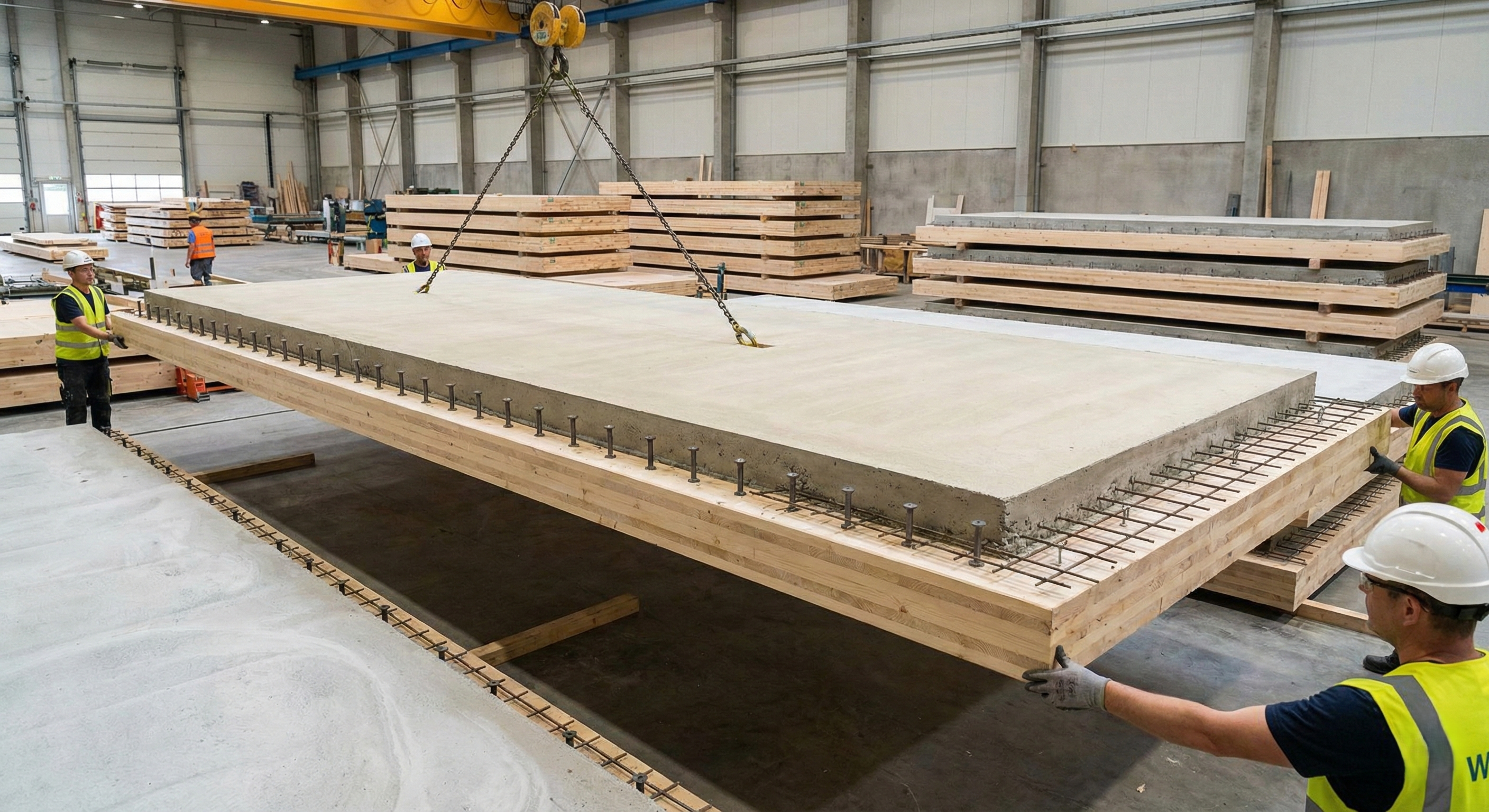
Sometimes, the most efficient engineering solution isn't pure wood or pure concrete-it is a marriage of the two.
Timber-Concrete Composite TCC systems are rapidly gaining popularity for floor assemblies where we need the best of both worlds.
In a TCC system, a layer of concrete, usually 2-4 inches, is poured directly on top of a mass timber panel, typically CLT or NLT.
The Composite Magic
Crucially, the concrete doesn't just sit there as dead weight. The two materials are mechanically locked together using shear connectors-heavy-duty screws, glued-in rods, or notched keys cut into the timber itself.
This connection forces the materials to act as a single structural unit:
- The Concrete handles the compressive forces at the top of the span.
- The Timber handles the tensile forces at the bottom.
Why Complicate It?
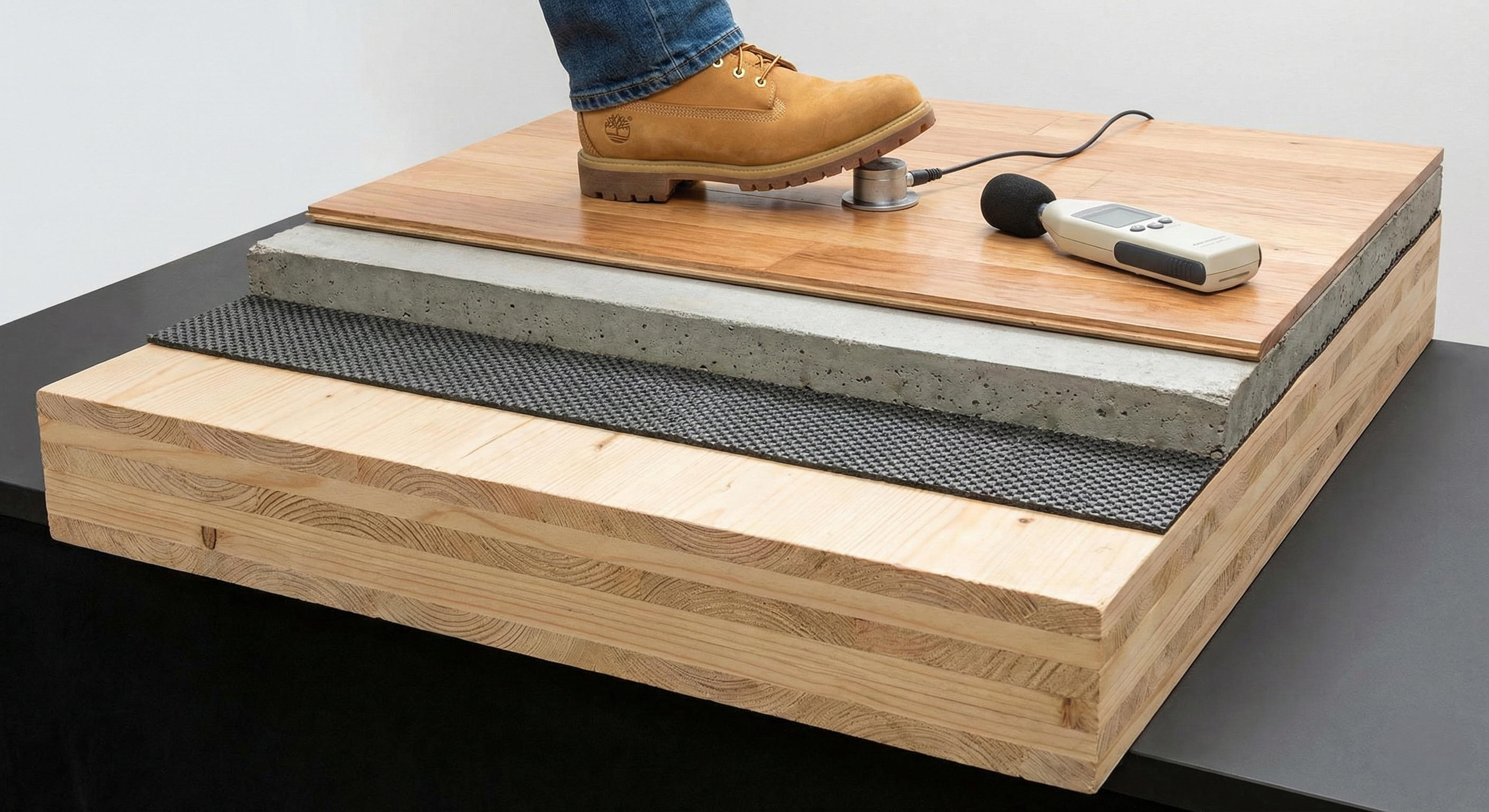
Why pour wet concrete on dry wood? It solves two of mass timber's biggest challenges: acoustics and vibration.
Mass timber is lightweight, which is great for foundations but can be problematic for footfall noise; a pure wood floor can sometimes feel bouncy.
By adding a thin layer of concrete, we add just enough thermal mass and density to dampen vibrations and block sound transmission, all while keeping the beautiful wood ceiling exposed below.
It is a pragmatic compromise that delivers high-performance spans without sacrificing the aesthetic.
How Mass Timber Is Made - And Why Prefabrication Changes Everything
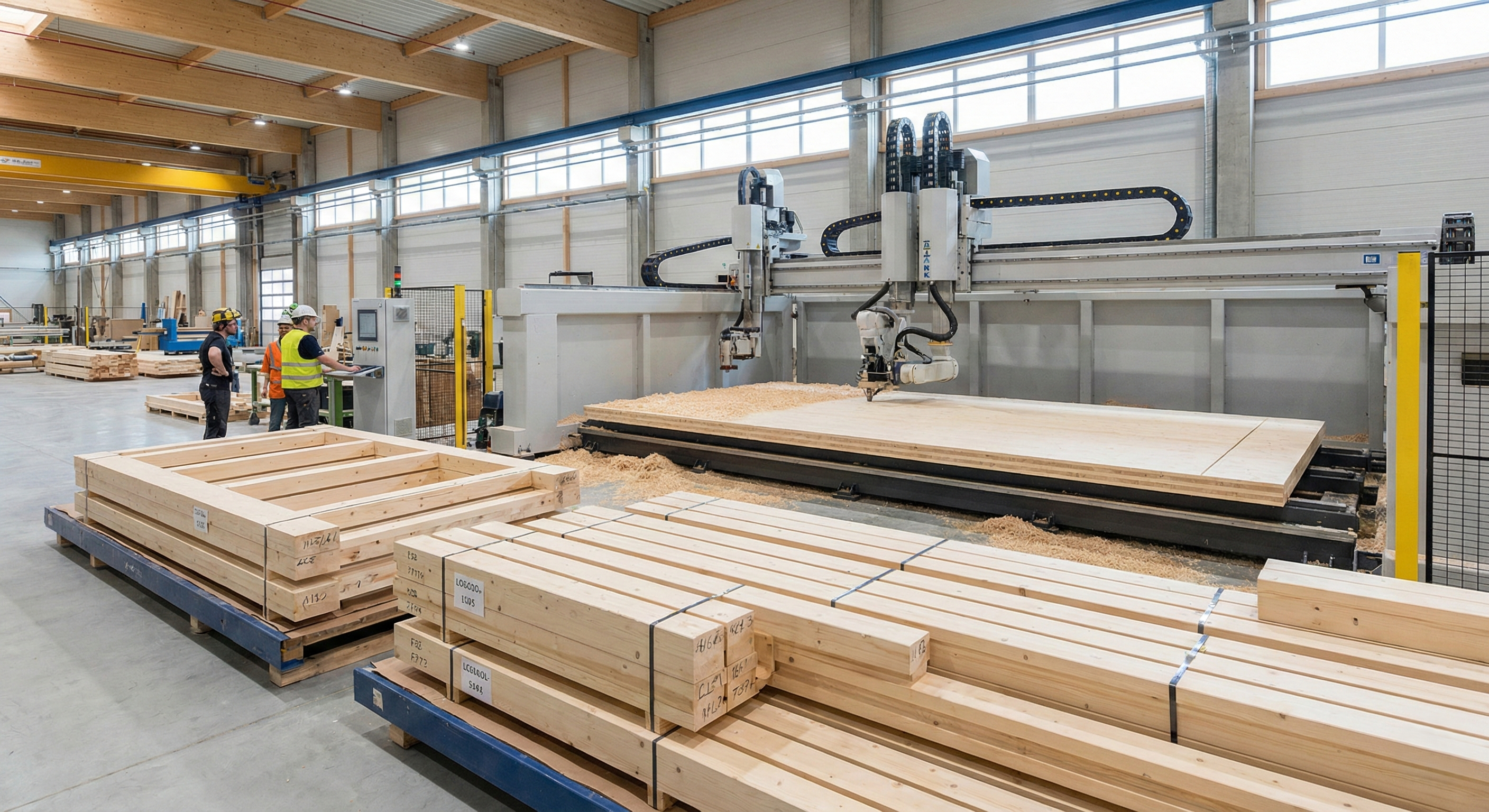
If you’re used to conventional concrete or steel workflows, mass timber can feel fast and clean on site.
That’s true, but it’s earned upstream in design and coordination. Here’s what’s happening behind the scenes and why it changes the project rhythm.
Layering And Bonding: Adhesives, Fasteners, Dowels, High-level
At a high level, mass timber products are created by combining smaller wood elements into larger structural pieces through bonding adhesives, mechanical fastening, or dowel systems, then machining them to precise geometry.
For an accessible overview of the manufacturing ecosystem and construction implications, see theGovernment of British Columbia's mass timber resource hub.
Digital Coordination BIM/VDC And Early Trade Integration
Because panels and members are fabricated to tight tolerances, coordination gets pulled earlier:
- Openings, penetrations, and edge conditions need decisions sooner.
- Connection concepts can’t be postponed detailing without risking rework.
- MEP routing and structure are often negotiated as a shared puzzle, not sequential handoffs.
The On-site Sequence Of What Goes Faster, What Must Happen Earlier
Here’s the trade:erection can be rapid, but only if procurement and detailing are mature enough. In many projects, teams commit earlier to:
- Final structural grid decisions
- Core strategy: concrete core, steel bracing, timber shear walls, hybrids
- Fire protection strategy exposed vs encapsulated areas
- Weather protection and moisture control plan
Illustrative Scenario: The Early Decision That Makes Or Breaks Speed.
Imagine a mid-rise office where the team wants exposed timber ceilings for warmth and brand identity. The structural concept uses CLT floors on glulam beams.
At schematic design, one question changes everything:Will the building allow exposed timber in occupied areas, or will it require encapsulation? That single decision affects:
- The fire protection strategy and approvals
- Ceiling assemblies and MEP routing
- Schedule because late changes become fabrication changes
Takeaway:once you understand the workflow shift, the next question is performance-strength, fire, seismic, and the comfort issues that make or break user experience.
The Why Factor: Engineering And Aesthetics
Why are developers and architects suddenly obsessed with wood? It comes down to two factors: the human experience and the construction timeline.
Biophilic Design: The Human Connection
We spend 90% of our time indoors. In a concrete box, our stress levels remain static. But research in biophilic design suggests that visible wood grain lowers heart rates and reduces stress, mimicking the physiological response of being in nature.
In my design practice, I treat the structure as the finish. We don't wrap mass timber columns in drywall; we celebrate them.
The knots, the grain, and the warmth become the interior design. This honest architecture connects occupants to the natural world in a way that steel simply cannot.
Prefabrication: Precision Off-Site
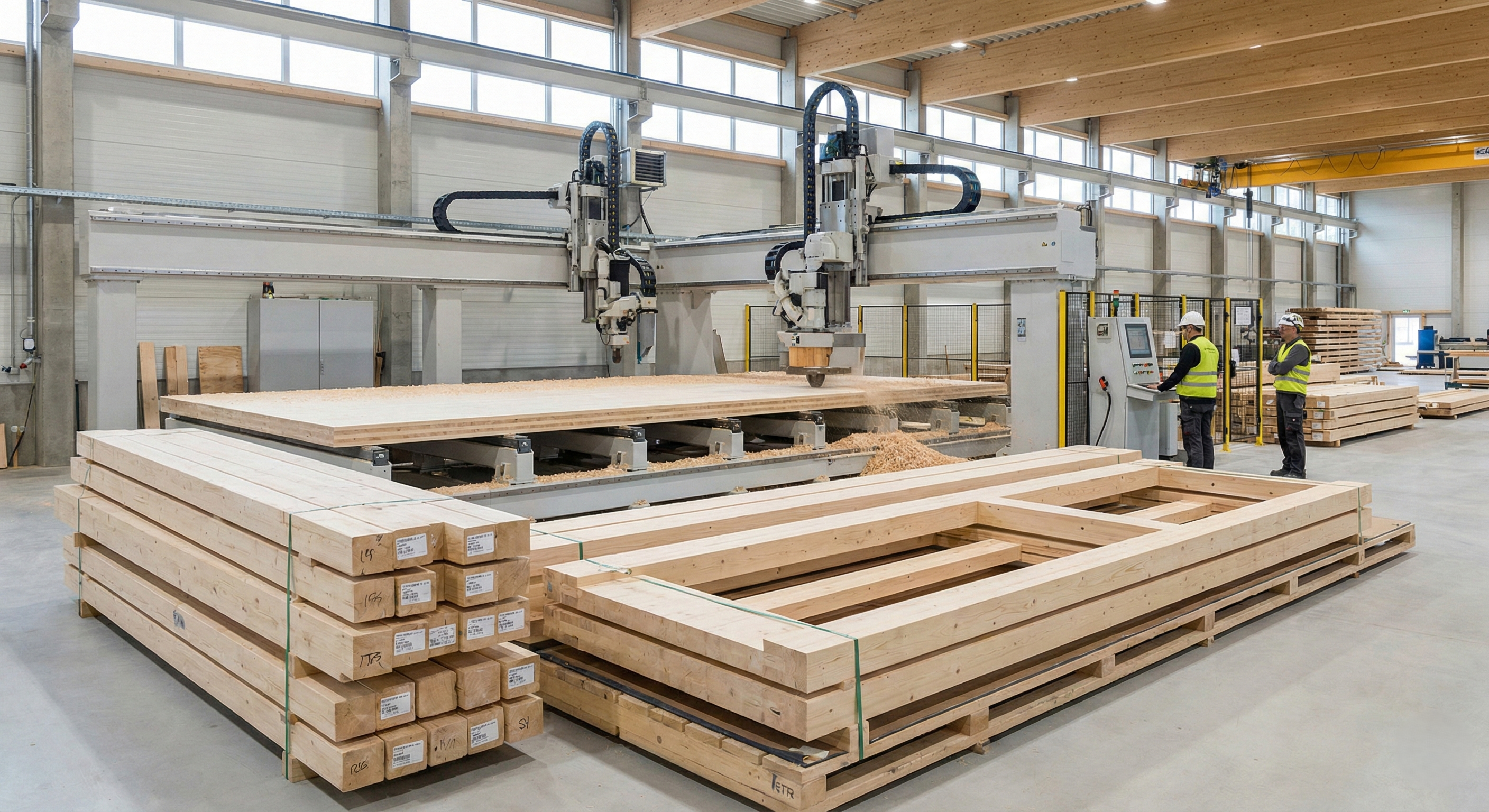
Mass timber is the closest construction gets to automotive manufacturing.
- Digital Twin:We model every single beam, connection, and screw hole in 3D software BIM before a tree is even cut.
- CNC Fabrication:The data is sent to a factory where Computer Numerical Control CNC machines cut the wood to within a millimeter of tolerance.
- Kit of Parts:The components arrive on site numbered and ready to assemble.
This process removes the chaos of the job site. There is no measuring or cutting in the mud. You simply lift the piece and bolt it in place.
Expert's Take:The Architect's Perspective for Designing
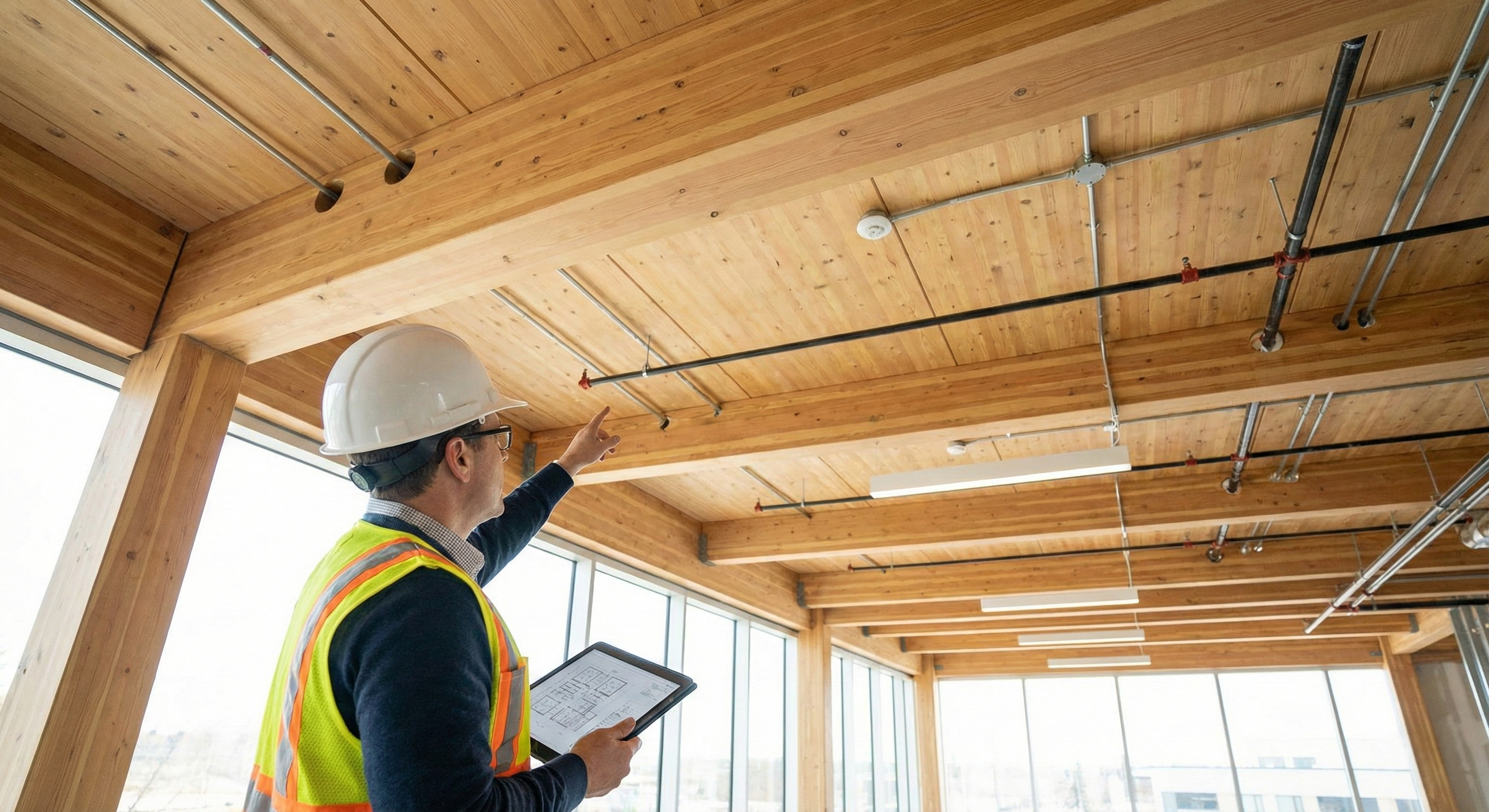
When designing with mass timber, the biggest challenge is the Mechanical, Electrical, and Plumbing MEP integration. In a concrete building, you can hide messy pipes above a dropped ceiling.
In mass timber, we often leave the ceiling exposed to show off the beautiful wood. This means every conduit, sprinkler pipe, and duct must be routed intentionally.
It forces a level of discipline in the design phase that results in a cleaner, more thoughtful building. We aren't just hiding the guts of the building; we are curating them.
Addressing The Safety Myths: Fire And Seismic
The most common question I get is, But won't it burn down? This fear is rooted in the confusion between light-frame wood kindling and mass timber logs.
The Charring Effect: Fire Resistance
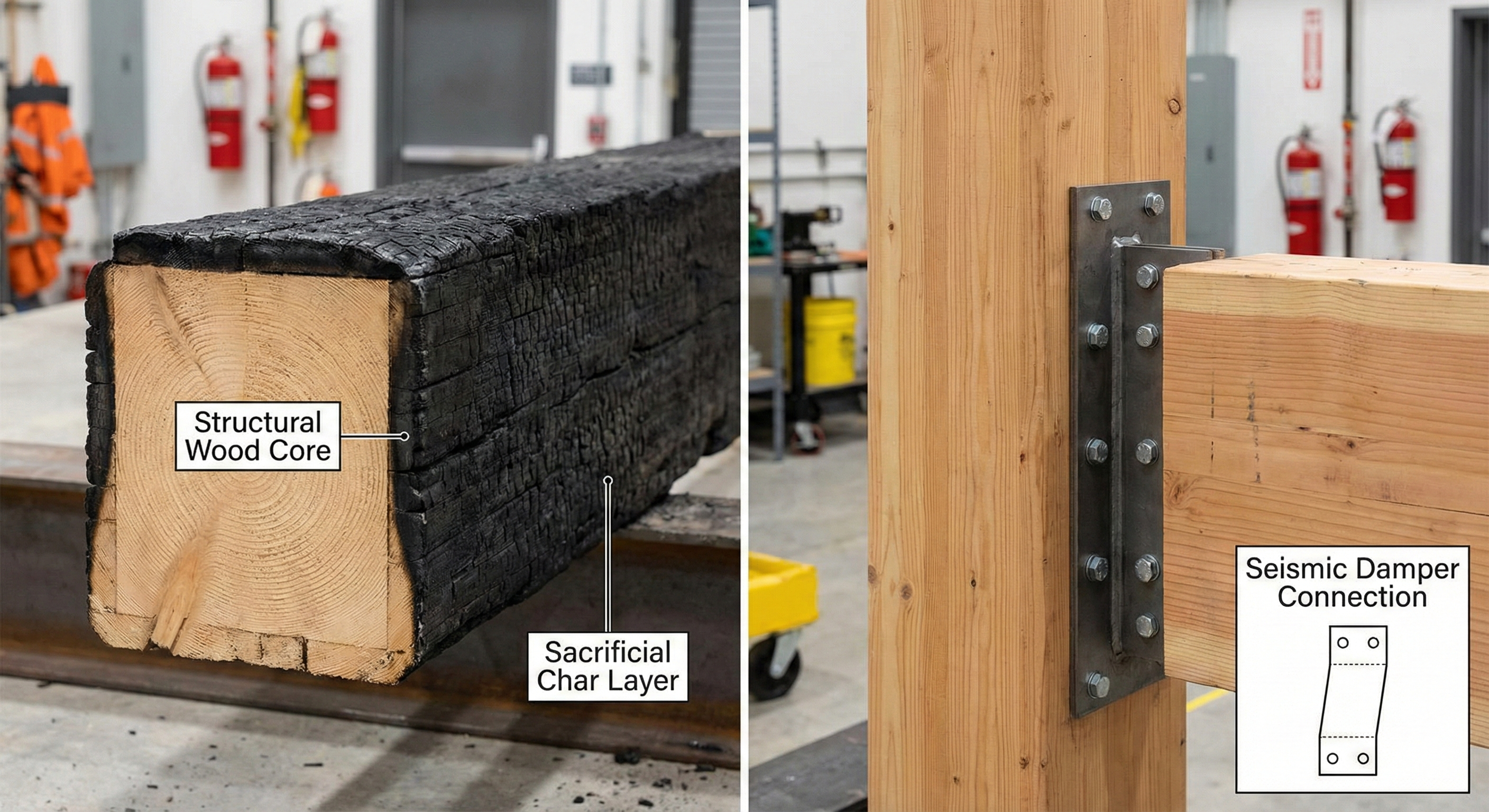
Mass timber does not burn like a 2x4. When exposed to fire, the outer layer of the wood chars. This black carbon layer acts as a natural insulator, protecting the inner core of cool, structural wood from the heat.
Engineering standards can predict this char rate precisely. We design the timber members to be oversized, calculating exactly how much sacrificial wood is needed to protect the structural core for 2 or 3 hours of fire exposure. It is a predictable, scientifically validated safety mechanism.
Seismic Resilience Earthquake Performance
Concrete is heavy and brittle; when the ground shakes, it cracks. Wood is lighter and ductile. It has a high strength-to-weight ratio and natural flexibility.
In seismic zones, mass timber buildings can dissipate energy rather than resisting it until failure. Connections, steel plates, and dowels are designed to yield and absorb the shock, keeping the timber elements intact.
The Sustainability Equation
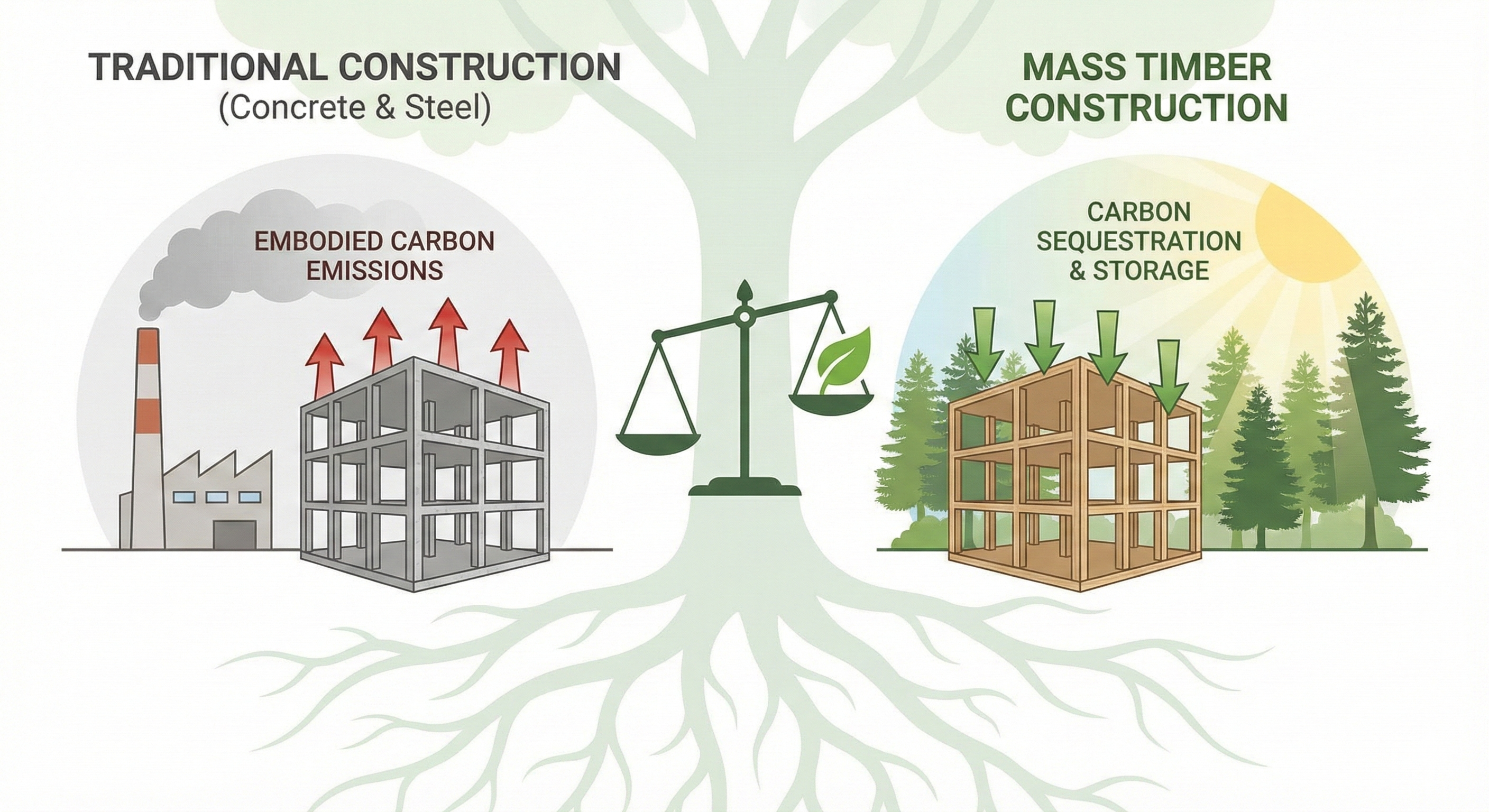
The construction industry is responsible for nearly 40% of global carbon emissions. Mass timber flips the script.
Embodied Carbon Vs. Operational Carbon
- Concrete and Steel:Producing cement and smelting steel releases massive amounts of CO2 into the atmosphere. This is embodied carbon.
- Mass Timber:Trees absorb CO2 as they grow. When we harvest them sustainably and lock them into a building, that carbon stays sequestered for the life of the structure.
A mass timber building effectively acts as a carbon bank. By replacing a concrete slab with CLT, we aren't just reducing emissions; we are storing carbon that was already removed from the atmosphere.
Sustainable Forestry And Sourcing
This system only works if the forests are managed responsibly. We rely on certifications like the FSC Forest Stewardship Council and SFI Sustainable Forestry Initiative to ensure that for every tree harvested, more are planted. The goal is to use young, fast-growing softwoods like spruce and pine rather than depleting old-growth forests.
Performance Realities: Strength, Fire, Seismic, And Comfort
This section gives you the practical truth behind the biggest performance questions, without the marketing gloss. You’ll walk away knowing what’s solidly understood, what depends on design, and what needs early attention.
Strength And Stiffness: Strong Enough Depends On System Design, Not Slogans
Mass timber can absolutely carry serious loads-but it isn’t a direct plug-and-play replacement for steel or concrete. The engineering questions are usually about:
- Spans and deflection stiffness matter as much as strength
- Connection behavior is often the governing detail in timber systems.
- Vibration and comfort, especially in office and residential floors
A responsible way to frame it is:mass timber can be designed to meet comparable structural demands, but the system panel thickness, beam spacing, connections, and composite action determine performance.
Acoustics/vibration: The Frequently Forgotten Design Layer
If there’s one gotcha that surprises first-time teams, it’s this: acoustics and vibration don’t solve themselves. Floor assemblies may need additional layers, detailing, or systems to meet comfort expectations, especially in residential or hospitality settings.
Myth Vs Reality Info-gain Insert
- Myth:Mass timber is automatically quieter and more comfortable.
- Reality:Comfort depends on the floor/ceiling assembly design, not the structural material alone.
- Myth:Fire safety is a non-issue because timber chars.Reality: Charring is one mechanism; code-compliant fire strategy and detailing still govern outcomes. SeeICC tall mass timber provisions.
Takeaway:performance is achievable, but it’s conditional, so the next step is being honest about risks and how strong teams manage them.
Risks And Limitations, And How Strong Teams Manage Them
Mass timber can be a high-confidence choice, but it rewards disciplined planning. This section turns the usual cons list into actionable controls-what to watch, why it matters, and how teams reduce risk.
Moisture Management: Design And Construction Controls That Reduce Risk
Moisture is the headline risk because wood is sensitive to prolonged wetting, and panels can be exposed during erection if weather protection isn’t planned.
Common controls include:
- A weather protection plan during erection sequencing, temporary membranes, and drainage
- Details that avoid water traps and allow drying
- Clear responsibilities for monitoring and documentation.
Mass Timber Construction Examples
This section helps you translate the concept into a practical one where it works, so you can evaluate fit without needing to memorize every product detail.
Mid-rise Residential And Mixed-use
Mass timber often shines in mid-rise projects where speed, weight, and repetitive floor plates matter. The structural rhythm of panels and frames can be a strong match if acoustics and fire strategy are integrated early.
Offices, Schools, And Civic Buildings
Projects that value warmth, biophilic aesthetics, and visible structure often explore exposed timber zones, especially offices and civic spaces. These uses also benefit from prefabrication when schedules are tight.
Hybrid Strategies: Timber Over Podiums, Timber With Concrete Cores
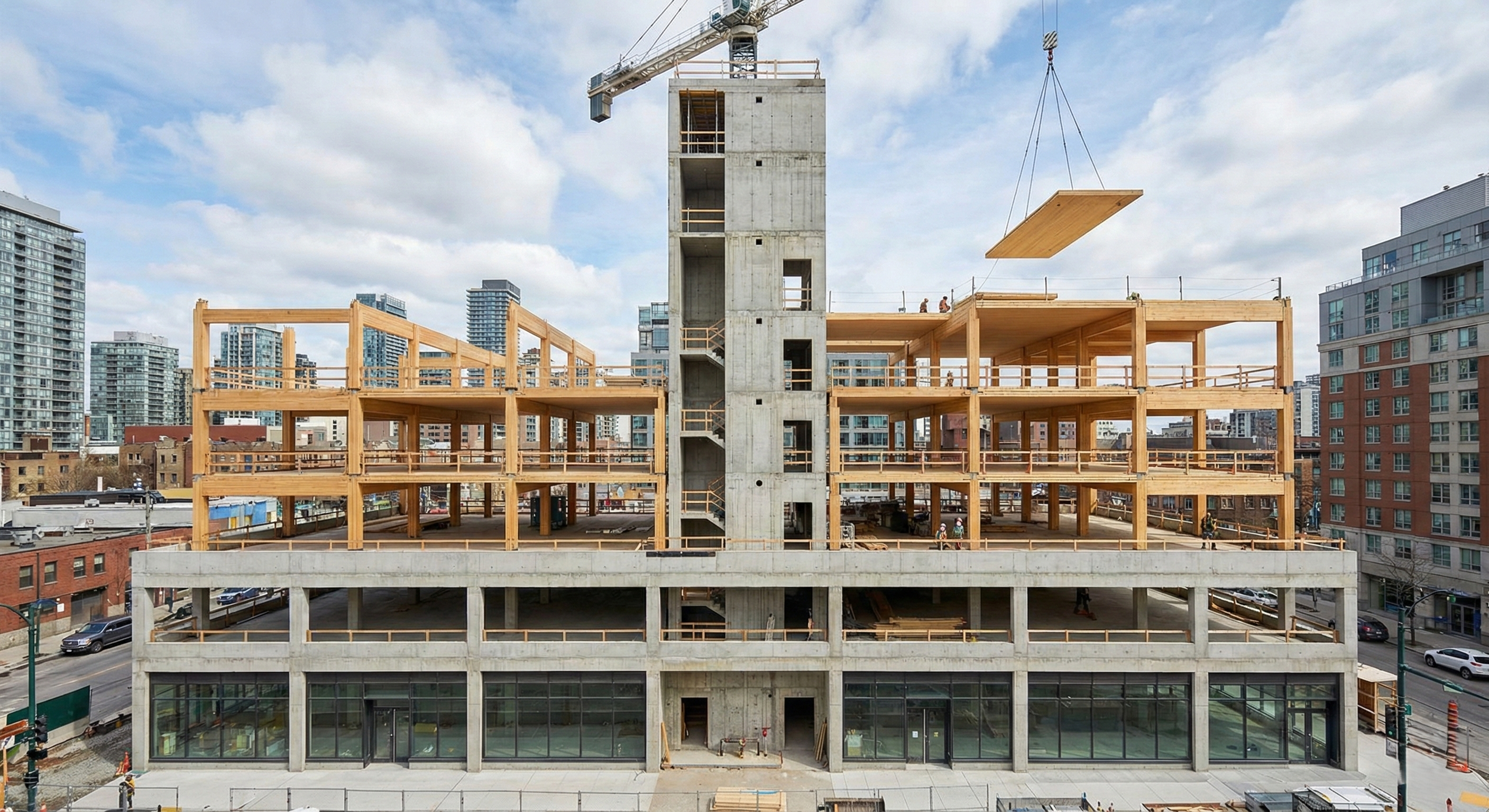
Hybrid solutions are common because they let each material do what it does best: timber for repetitive floors and speed, concrete/steel for cores, podiums, or other performance drivers. TheGovernment of BC's mass timber hubincludes a broader ecosystem view that supports this system selection mindset.
2-column Decision Table: Design Goal → Typical Mass Timber Approach Info-gain Insert
| If your priority is | A common mass timber strategy is |
| Fast erection and clean site logistics | CLT floor/roof panels with a glulam frame and early-coordinated connections |
| Exposed-wood ceilings for warmth | CLT or NLT/DLT decking with a fire strategy that defines where exposure is allowed |
| Reduced structural weight | Timber superstructure paired with a concrete or steel core, where needed |
| Repetitive floor plates and predictable installation | Standardized panel sizes, consistent grids, and early MEP opening coordination |
| Risk reduction in wet climates | More robust weather protection sequencing and enclosure-first planning |
Takeaway:Now that fit is clearer, the remaining work is answering the common comparison questions people ask when they’re about to make a real decision.
Where Can I Purchase Mass Timber For U.S. Projects?
If you are looking for mass timber in the aisle of your local Home Depot, you will be disappointed. You do not just buy mass timber; you commission it.
Because every panel is custom-fabricated to millimeter precision based on your specific digital model BIM, the procurement process is entirely different from buying steel or commodity lumber. It requires early engagement-often months before a shovel hits the ground.
The Major North American Players
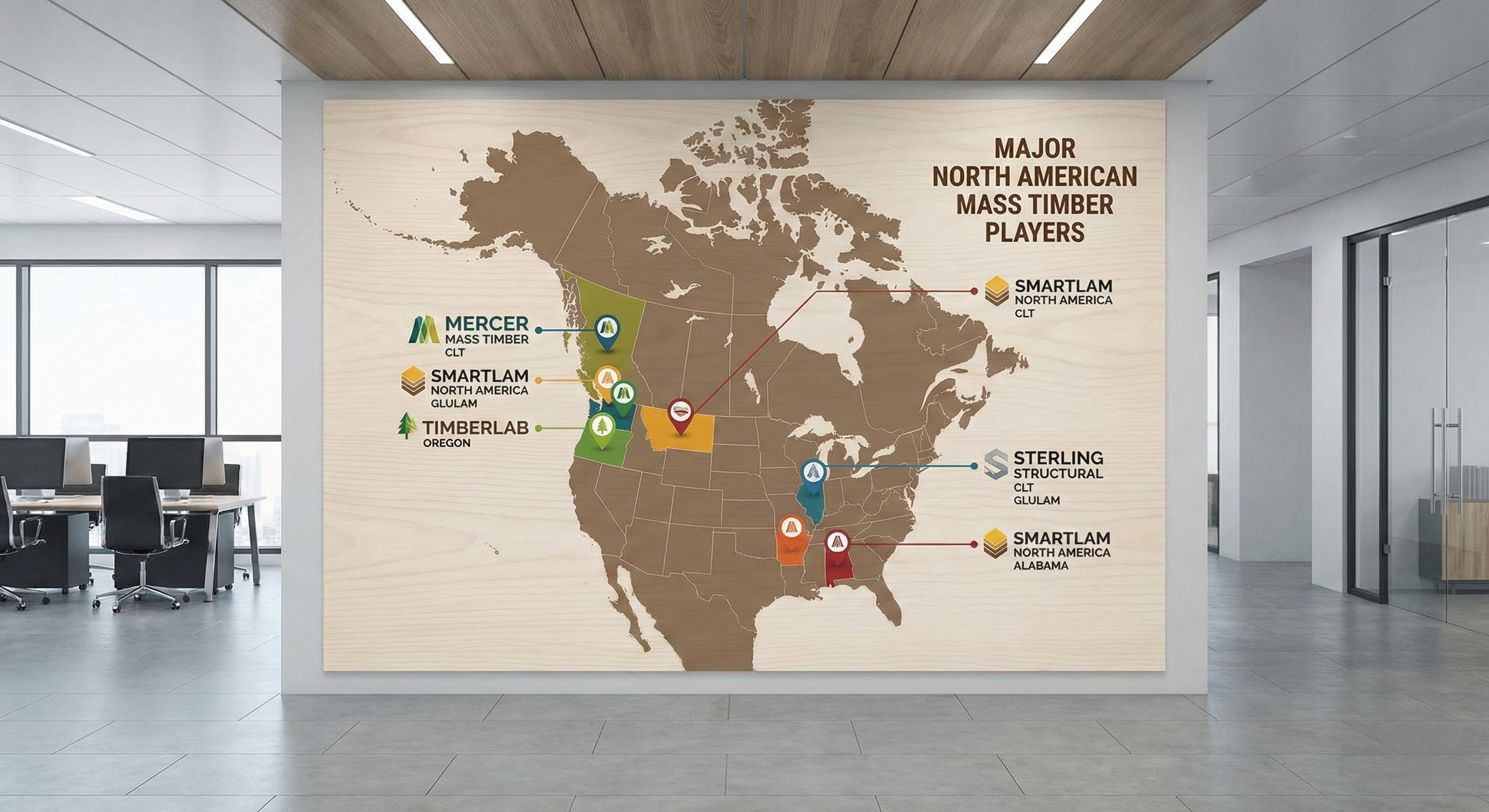
The U.S. supply chain is robust and growing, primarily split between the Pacific Northwest, rich in Douglas Fir, and the Southeast, Southern Yellow Pine, with significant imports from Canadian partners who service the U.S. market.
- Mercer Mass Timber:A heavy hitter with massive capacity, operating out of Washington, Arkansas, and British Columbia. They are a go-to for large-scale commercial projects.
- SmartLam North America:The first CLT manufacturer in the U.S., with facilities in Montana and Alabama, covering both sides of the country.
- Timberlab:Originally an affiliate of Swinerton Builders, they have expanded into a full-service provider offering both fabrication and engineering services in Oregon.
- Sterling Structural:Based in Illinois, they are a key player known for their TerraLam CLT, often used in industrial and matting applications but increasingly in building structures.
- Kalesnikoff:While based in British Columbia, they are a premier supplier for many high-profile U.S. projects, known for high aesthetic, architectural-grade glulam and CLT.
The WoodWorks Directory
For architects and developers, the most essential tool for sourcing is the WoodWorks Innovation Network WIN. It is a comprehensive, non-profit map of manufacturers, installers, and engineers.
Reality Check For U.S. Projects: What’s Universal Vs. What Depends On The Job
This is the short section I’d add to keep the article architecturally honest and to protect you from the two things AI Overviews punish most: uncited stats and over-generalized promises.
- Code reality U.S. lens:The model International Building Code IBC includes three mass timber construction types-IV-A, IV-B, and IV-C, commonly summarized as allowing mass timber up to 18, 12, and 9 stories, respectively. But adoption and enforcement are local. Treat those limits as possible under the model code, then confirm what your AHJ authority having jurisdiction has adopted and how they interpret exposed timber allowances.
- Speed claims need context:You’ll see numbers like 25% faster in the wild. The most defensible way to use them is as project-reported estimates - for example, developers of the Ascent tower said mass timber was 25% faster than traditional construction for that project.
- Sustainability claims should be scoped, not hyped:The built environment is indeed a major climate lever, but it’s better to cite it precisely: UNEP reports the buildings and construction sector accounts for about 21% of global greenhouse gas emissions, and in 2022 buildings were responsible for 34% of global energy demand and 37% of energy - and process-related CO₂ emissions. Mass timber can help, especially on embodied carbon, but results depend on sourcing, design efficiency, and what it replaces.
- Procurement is documentation as much as material:For U.S. projects using CLT, ask suppliers how they demonstrate compliance with the ANSI/APA PRG 320 standard, manufacturing, qualification, and quality assurance. And if you want a neutral place to build a shortlist, start with industry directories like the WoodWorks tall mass timber resources/partner ecosystem rather than relying only on vendor lists.
Also Check Out: how to choose a commercial architect
Frequently Asked Questions
What Is Mass Timber Construction?
Mass timber construction uses large engineered wood panels and members as the building’s primary structure, usually prefabricated and assembled quickly on site.
What’s The Difference Between Lumber And Mass Timber?
Lumber is individual wood pieces, boards, and studs. Mass timber combines wood into larger engineered structural panels, beams, and columns designed to carry major loads.
Is Mass Timber The Same As Timber Frame?
No. Timber frame usually refers to post-and-beam systems with traditional joinery. Mass timber uses engineered panels/members and modern connection systems.
What Are The Main Types Of Mass Timber?
The most common types are CLT, glulam, NLT, and DLT. They’re engineered differently and used for different roles like floors, walls, beams, and columns.
How Is Mass Timber Made?
Smaller wood elements are layered and bonded with adhesives, fasteners, or dowels, then precision-cut for assembly as panels or structural members.
Is CLT Basically Plywood?
Not really. CLT is made from thick lumber layers laminated in alternating directions; plywood uses thin veneers and behaves differently structurally.
Is Mass Timber As Strong As Steel Or Concrete?
It can meet similar structural demands, but performance depends on the system, spans, connections, and design goals-there isn’t a universal one-to-one swap.
Is Mass Timber Fire Safe?
Properly designed mass timber can perform well in fire because heavy sections char predictably, and codes specify protection and detailing strategies for required fire resistance.
How Tall Can Mass Timber Buildings Be?
Some modern codes include pathways for tall mass timber construction types, but allowable height and occupancy limits vary by jurisdiction and approval context.
What Are The Biggest Risks Of Mass Timber?
Moisture exposure, coordination complexity, permitting variability, procurement timing, and insurance requirements are the most common practical risks.
Is Mass Timber Sustainable?
It can be, especially when responsibly sourced and used to replace higher-embodied-carbon materials, but impacts are best evaluated project-by-project.
Does Mass Timber Reduce Construction Time?
Often yes, because components are prefabricated and erection can be fast. The tradeoff is earlier coordination and earlier commitment to key decisions.
What Buildings Are Best Suited For Mass Timber?
Mid-rise residential, offices, schools, and civic buildings often benefit when speed, weight, and exposed-wood aesthetics matter and early coordination is feasible.
What Are Examples Of Mass Timber Buildings?
Examples include mid-rise schools, offices, and residential buildings, plus some taller hybrid projects; the useful lesson is how panels, frames, and cores are combined.
What Should I Ask Before Choosing Mass Timber?
Ask about code pathway, fire strategy, enclosure/moisture plan, supplier capacity, acoustic/vibration requirements, insurance expectations, and how MEP/structure will be coordinated.
Conclusion
Mass timber construction is best understood as a system choice, not a stylistic one. When it works, it’s because early decisions, grid, fire strategy, coordination, and moisture control are handled with discipline, turning prefabrication into real schedule and quality gains.
If you’re evaluating a project, start with the readiness checklist and decision table above, then bring your structural engineer, builder, and enclosure specialist into the conversation early. Mass timber rewards teams who decide sooner, not later.
If this helped, share it with someone on your team who keeps hearing mass timber and wants the plain-English version.
Walk onto a traditional construction site, and your senses are assaulted. The air is thick with silica dust; the noise of jackhammers and grinding metal is deafening. It is a chaotic, gray environment.
Now, step onto a mass timber site. The difference is jarring in the best possible way. The air smells of pine and spruce.
The noise level is dramatically lower, dominated by the hum of electric cranes and the rhythmic thud of mallets rather than the screech of grinders. It feels less like a construction zone and more like a precise assembly lab.
This is the world of Mass Timber Construction, a building methodology that is not merely a return to wood, but a leap forward into high-performance engineering.
It is where the ancient warmth of timber meets the cutting-edge precision of modern manufacturing, creating structures that are lighter, faster to build, and arguably more human than anything we have built in the last century.
Key Takeaways:
- What is it?A construction method using large, solid engineered wood panels and beams like CLT and Glulam for load-bearing structures.
- Key Benefit:Offers the structural strength of steel and concrete but weighs approximately 20% as much.
- Sustainability:Sequesters carbon dioxide within the building fabric rather than emitting it during production.
- Speed:Components are prefabricated off-site to millimeter precision, allowing for 25% faster on-site assembly.
- Safety:Large timber sections are inherently fire-resistant due to charring, which insulates the structural core.
The One-Sentence Definition
Mass timber construction is building with large, engineered wood structural components-panels, beams, and columns manufactured with precision and assembled as the building’s primary structural system.
Takeaway to carry forward:once you see mass timber as a system, not a vibe, the benefits and limitations become much easier to judge.
Mass Timber Vs Light-frame Wood
Light-frame construction, the typical stick-built approach, relies on many small members - studs, joists, rafters repeating at close spacing. Mass timber construction uses fewer, larger structural elements that do more work per piece.
That difference matters because it affects:
- Coordination:fewer pieces, but each piece is more final, so coordination happens earlier.
- Erection:a crane and an installation sequence often replace long stretches of on-site framing.
- Performance detailing:acoustics, vibration, fire strategy, and connections become first-order design decisions.
Takeaway:The next common confusion is mixing up mass timber with timber frame and heavy timber, so let’s separate those cleanly.
The Mass Timber Family CLT, Glulam, NLT, DLT, And Beyond
Mass timber isn’t one product-it’s a set of products you combine into a structural strategy. In this section, you’ll learn what each major product is and where it tends to make sense, so you can stop treating them like one interchangeable material.
CLT: Panels For Floors, Roofs, And Walls
Cross-laminated timber CLT is made by stacking lumber layers at alternating directions and bonding them into thick panels.
The result is a stiff, dimensionally stable structural plate that can be used for floors, roofs, and walls.
If you want a standards-based reference point, theANSI/APA PRG 320 standard for CLTis the key North American performance and qualification document.
Glulam: Beams And Columns, And Why It Pairs Well With CLT
Glulam glue-laminated timber is built from lumber laminations bonded together to form strong, predictable beams and columns.
It’s commonly paired with CLT: glulam frames carry loads; CLT spans between them as floor and roof plates.
NLT And DLT: Solid-Lumber Panel Systems
Nail - laminated timber NLT and dowel - laminated timber DLT are panel systems made from dimensional lumber stacked on edge and fastened together - NLT with nails/screws, DLT with hardwood dowels.
They’re often used for floors and roofs where a solid-wood panel aesthetic is desired and where the structural concept fits.
MPP/SCL: Where Mass Timber Overlaps With Other Engineered Systems
Some discussions include products like mass plywood panels MPP or other structural composite lumber SCL systems in the broader conversation, because they share the theme of large engineered wood elements.
The practical point: not every engineered wood product is mass timber in the same way, and code/acceptance can differ by product and jurisdiction.
A Simple 2-column Cheat Sheet Structured Element
| Product | Typical role in a building |
| CLT | Floor/roof/wall panels; diaphragm and plate behavior |
| Glulam | Beams and columns; primary frame lines |
| NLT | Floor/roof panels; often exposed decking aesthetic |
| DLT | Floor/roof panels; exposed aesthetic without metal fasteners in the face |
| Other engineered panels, e.g., MPP | Varies by system; often floors/roofs in specific markets |
Takeaway:Knowing the products is only half the story-mass timber changes when decisions happen because so much is prefabricated.
Timber-Concrete Composite TCC Floor Systems
Sometimes, the most efficient engineering solution isn't pure wood or pure concrete-it is a marriage of the two.
Timber-Concrete Composite TCC systems are rapidly gaining popularity for floor assemblies where we need the best of both worlds.
In a TCC system, a layer of concrete, usually 2-4 inches, is poured directly on top of a mass timber panel, typically CLT or NLT.
The Composite Magic
Crucially, the concrete doesn't just sit there as dead weight. The two materials are mechanically locked together using shear connectors-heavy-duty screws, glued-in rods, or notched keys cut into the timber itself.
This connection forces the materials to act as a single structural unit:
- The Concrete handles the compressive forces at the top of the span.
- The Timber handles the tensile forces at the bottom.
Why Complicate It?
Why pour wet concrete on dry wood? It solves two of mass timber's biggest challenges: acoustics and vibration.
Mass timber is lightweight, which is great for foundations but can be problematic for footfall noise; a pure wood floor can sometimes feel bouncy.
By adding a thin layer of concrete, we add just enough thermal mass and density to dampen vibrations and block sound transmission, all while keeping the beautiful wood ceiling exposed below.
It is a pragmatic compromise that delivers high-performance spans without sacrificing the aesthetic.
How Mass Timber Is Made - And Why Prefabrication Changes Everything
If you’re used to conventional concrete or steel workflows, mass timber can feel fast and clean on site.
That’s true, but it’s earned upstream in design and coordination. Here’s what’s happening behind the scenes and why it changes the project rhythm.
Layering And Bonding: Adhesives, Fasteners, Dowels, High-level
At a high level, mass timber products are created by combining smaller wood elements into larger structural pieces through bonding adhesives, mechanical fastening, or dowel systems, then machining them to precise geometry.
For an accessible overview of the manufacturing ecosystem and construction implications, see theGovernment of British Columbia's mass timber resource hub.
Digital Coordination BIM/VDC And Early Trade Integration
Because panels and members are fabricated to tight tolerances, coordination gets pulled earlier:
- Openings, penetrations, and edge conditions need decisions sooner.
- Connection concepts can’t be postponed detailing without risking rework.
- MEP routing and structure are often negotiated as a shared puzzle, not sequential handoffs.
The On-site Sequence Of What Goes Faster, What Must Happen Earlier
Here’s the trade:erection can be rapid, but only if procurement and detailing are mature enough. In many projects, teams commit earlier to:
- Final structural grid decisions
- Core strategy: concrete core, steel bracing, timber shear walls, hybrids
- Fire protection strategy exposed vs encapsulated areas
- Weather protection and moisture control plan
Illustrative Scenario: The Early Decision That Makes Or Breaks Speed.
Imagine a mid-rise office where the team wants exposed timber ceilings for warmth and brand identity. The structural concept uses CLT floors on glulam beams.
At schematic design, one question changes everything:Will the building allow exposed timber in occupied areas, or will it require encapsulation? That single decision affects:
- The fire protection strategy and approvals
- Ceiling assemblies and MEP routing
- Schedule because late changes become fabrication changes
Takeaway:once you understand the workflow shift, the next question is performance-strength, fire, seismic, and the comfort issues that make or break user experience.
The Why Factor: Engineering And Aesthetics
Why are developers and architects suddenly obsessed with wood? It comes down to two factors: the human experience and the construction timeline.
Biophilic Design: The Human Connection
We spend 90% of our time indoors. In a concrete box, our stress levels remain static. But research in biophilic design suggests that visible wood grain lowers heart rates and reduces stress, mimicking the physiological response of being in nature.
In my design practice, I treat the structure as the finish. We don't wrap mass timber columns in drywall; we celebrate them.
The knots, the grain, and the warmth become the interior design. This honest architecture connects occupants to the natural world in a way that steel simply cannot.
Prefabrication: Precision Off-Site
Mass timber is the closest construction gets to automotive manufacturing.
- Digital Twin:We model every single beam, connection, and screw hole in 3D software BIM before a tree is even cut.
- CNC Fabrication:The data is sent to a factory where Computer Numerical Control CNC machines cut the wood to within a millimeter of tolerance.
- Kit of Parts:The components arrive on site numbered and ready to assemble.
This process removes the chaos of the job site. There is no measuring or cutting in the mud. You simply lift the piece and bolt it in place.
Expert's Take:The Architect's Perspective for Designing
When designing with mass timber, the biggest challenge is the Mechanical, Electrical, and Plumbing MEP integration. In a concrete building, you can hide messy pipes above a dropped ceiling.
In mass timber, we often leave the ceiling exposed to show off the beautiful wood. This means every conduit, sprinkler pipe, and duct must be routed intentionally.
It forces a level of discipline in the design phase that results in a cleaner, more thoughtful building. We aren't just hiding the guts of the building; we are curating them.
Addressing The Safety Myths: Fire And Seismic
The most common question I get is, But won't it burn down? This fear is rooted in the confusion between light-frame wood kindling and mass timber logs.
The Charring Effect: Fire Resistance
Mass timber does not burn like a 2x4. When exposed to fire, the outer layer of the wood chars. This black carbon layer acts as a natural insulator, protecting the inner core of cool, structural wood from the heat.
Engineering standards can predict this char rate precisely. We design the timber members to be oversized, calculating exactly how much sacrificial wood is needed to protect the structural core for 2 or 3 hours of fire exposure. It is a predictable, scientifically validated safety mechanism.
Seismic Resilience Earthquake Performance
Concrete is heavy and brittle; when the ground shakes, it cracks. Wood is lighter and ductile. It has a high strength-to-weight ratio and natural flexibility.
In seismic zones, mass timber buildings can dissipate energy rather than resisting it until failure. Connections, steel plates, and dowels are designed to yield and absorb the shock, keeping the timber elements intact.
The Sustainability Equation
The construction industry is responsible for nearly 40% of global carbon emissions. Mass timber flips the script.
Embodied Carbon Vs. Operational Carbon
- Concrete and Steel:Producing cement and smelting steel releases massive amounts of CO2 into the atmosphere. This is embodied carbon.
- Mass Timber:Trees absorb CO2 as they grow. When we harvest them sustainably and lock them into a building, that carbon stays sequestered for the life of the structure.
A mass timber building effectively acts as a carbon bank. By replacing a concrete slab with CLT, we aren't just reducing emissions; we are storing carbon that was already removed from the atmosphere.
Sustainable Forestry And Sourcing
This system only works if the forests are managed responsibly. We rely on certifications like the FSC Forest Stewardship Council and SFI Sustainable Forestry Initiative to ensure that for every tree harvested, more are planted. The goal is to use young, fast-growing softwoods like spruce and pine rather than depleting old-growth forests.
Performance Realities: Strength, Fire, Seismic, And Comfort
This section gives you the practical truth behind the biggest performance questions, without the marketing gloss. You’ll walk away knowing what’s solidly understood, what depends on design, and what needs early attention.
Strength And Stiffness: Strong Enough Depends On System Design, Not Slogans
Mass timber can absolutely carry serious loads-but it isn’t a direct plug-and-play replacement for steel or concrete. The engineering questions are usually about:
- Spans and deflection stiffness matter as much as strength
- Connection behavior is often the governing detail in timber systems.
- Vibration and comfort, especially in office and residential floors
A responsible way to frame it is:mass timber can be designed to meet comparable structural demands, but the system panel thickness, beam spacing, connections, and composite action determine performance.
Acoustics/vibration: The Frequently Forgotten Design Layer
If there’s one gotcha that surprises first-time teams, it’s this: acoustics and vibration don’t solve themselves. Floor assemblies may need additional layers, detailing, or systems to meet comfort expectations, especially in residential or hospitality settings.
Myth Vs Reality Info-gain Insert
- Myth:Mass timber is automatically quieter and more comfortable.
- Reality:Comfort depends on the floor/ceiling assembly design, not the structural material alone.
- Myth:Fire safety is a non-issue because timber chars.Reality: Charring is one mechanism; code-compliant fire strategy and detailing still govern outcomes. SeeICC tall mass timber provisions.
Takeaway:performance is achievable, but it’s conditional, so the next step is being honest about risks and how strong teams manage them.
Risks And Limitations, And How Strong Teams Manage Them
Mass timber can be a high-confidence choice, but it rewards disciplined planning. This section turns the usual cons list into actionable controls-what to watch, why it matters, and how teams reduce risk.
Moisture Management: Design And Construction Controls That Reduce Risk
Moisture is the headline risk because wood is sensitive to prolonged wetting, and panels can be exposed during erection if weather protection isn’t planned.
Common controls include:
- A weather protection plan during erection sequencing, temporary membranes, and drainage
- Details that avoid water traps and allow drying
- Clear responsibilities for monitoring and documentation.
Mass Timber Construction Examples
This section helps you translate the concept into a practical one where it works, so you can evaluate fit without needing to memorize every product detail.
Mid-rise Residential And Mixed-use
Mass timber often shines in mid-rise projects where speed, weight, and repetitive floor plates matter. The structural rhythm of panels and frames can be a strong match if acoustics and fire strategy are integrated early.
Offices, Schools, And Civic Buildings
Projects that value warmth, biophilic aesthetics, and visible structure often explore exposed timber zones, especially offices and civic spaces. These uses also benefit from prefabrication when schedules are tight.
Hybrid Strategies: Timber Over Podiums, Timber With Concrete Cores
Hybrid solutions are common because they let each material do what it does best: timber for repetitive floors and speed, concrete/steel for cores, podiums, or other performance drivers. TheGovernment of BC's mass timber hubincludes a broader ecosystem view that supports this system selection mindset.
2-column Decision Table: Design Goal → Typical Mass Timber Approach Info-gain Insert
| If your priority is | A common mass timber strategy is |
| Fast erection and clean site logistics | CLT floor/roof panels with a glulam frame and early-coordinated connections |
| Exposed-wood ceilings for warmth | CLT or NLT/DLT decking with a fire strategy that defines where exposure is allowed |
| Reduced structural weight | Timber superstructure paired with a concrete or steel core, where needed |
| Repetitive floor plates and predictable installation | Standardized panel sizes, consistent grids, and early MEP opening coordination |
| Risk reduction in wet climates | More robust weather protection sequencing and enclosure-first planning |
Takeaway:Now that fit is clearer, the remaining work is answering the common comparison questions people ask when they’re about to make a real decision.
Where Can I Purchase Mass Timber For U.S. Projects?
If you are looking for mass timber in the aisle of your local Home Depot, you will be disappointed. You do not just buy mass timber; you commission it.
Because every panel is custom-fabricated to millimeter precision based on your specific digital model BIM, the procurement process is entirely different from buying steel or commodity lumber. It requires early engagement-often months before a shovel hits the ground.
The Major North American Players
The U.S. supply chain is robust and growing, primarily split between the Pacific Northwest, rich in Douglas Fir, and the Southeast, Southern Yellow Pine, with significant imports from Canadian partners who service the U.S. market.
- Mercer Mass Timber:A heavy hitter with massive capacity, operating out of Washington, Arkansas, and British Columbia. They are a go-to for large-scale commercial projects.
- SmartLam North America:The first CLT manufacturer in the U.S., with facilities in Montana and Alabama, covering both sides of the country.
- Timberlab:Originally an affiliate of Swinerton Builders, they have expanded into a full-service provider offering both fabrication and engineering services in Oregon.
- Sterling Structural:Based in Illinois, they are a key player known for their TerraLam CLT, often used in industrial and matting applications but increasingly in building structures.
- Kalesnikoff:While based in British Columbia, they are a premier supplier for many high-profile U.S. projects, known for high aesthetic, architectural-grade glulam and CLT.
The WoodWorks Directory
For architects and developers, the most essential tool for sourcing is the WoodWorks Innovation Network WIN. It is a comprehensive, non-profit map of manufacturers, installers, and engineers.
Reality Check For U.S. Projects: What’s Universal Vs. What Depends On The Job
This is the short section I’d add to keep the article architecturally honest and to protect you from the two things AI Overviews punish most: uncited stats and over-generalized promises.
- Code reality U.S. lens:The model International Building Code IBC includes three mass timber construction types-IV-A, IV-B, and IV-C, commonly summarized as allowing mass timber up to 18, 12, and 9 stories, respectively. But adoption and enforcement are local. Treat those limits as possible under the model code, then confirm what your AHJ authority having jurisdiction has adopted and how they interpret exposed timber allowances.
- Speed claims need context:You’ll see numbers like 25% faster in the wild. The most defensible way to use them is as project-reported estimates - for example, developers of the Ascent tower said mass timber was 25% faster than traditional construction for that project.
- Sustainability claims should be scoped, not hyped:The built environment is indeed a major climate lever, but it’s better to cite it precisely: UNEP reports the buildings and construction sector accounts for about 21% of global greenhouse gas emissions, and in 2022 buildings were responsible for 34% of global energy demand and 37% of energy - and process-related CO₂ emissions. Mass timber can help, especially on embodied carbon, but results depend on sourcing, design efficiency, and what it replaces.
- Procurement is documentation as much as material:For U.S. projects using CLT, ask suppliers how they demonstrate compliance with the ANSI/APA PRG 320 standard, manufacturing, qualification, and quality assurance. And if you want a neutral place to build a shortlist, start with industry directories like the WoodWorks tall mass timber resources/partner ecosystem rather than relying only on vendor lists.
Also Check Out: how to choose a commercial architect
Frequently Asked Questions
What Is Mass Timber Construction?
Mass timber construction uses large engineered wood panels and members as the building’s primary structure, usually prefabricated and assembled quickly on site.
What’s The Difference Between Lumber And Mass Timber?
Lumber is individual wood pieces, boards, and studs. Mass timber combines wood into larger engineered structural panels, beams, and columns designed to carry major loads.
Is Mass Timber The Same As Timber Frame?
No. Timber frame usually refers to post-and-beam systems with traditional joinery. Mass timber uses engineered panels/members and modern connection systems.
What Are The Main Types Of Mass Timber?
The most common types are CLT, glulam, NLT, and DLT. They’re engineered differently and used for different roles like floors, walls, beams, and columns.
How Is Mass Timber Made?
Smaller wood elements are layered and bonded with adhesives, fasteners, or dowels, then precision-cut for assembly as panels or structural members.
Is CLT Basically Plywood?
Not really. CLT is made from thick lumber layers laminated in alternating directions; plywood uses thin veneers and behaves differently structurally.
Is Mass Timber As Strong As Steel Or Concrete?
It can meet similar structural demands, but performance depends on the system, spans, connections, and design goals-there isn’t a universal one-to-one swap.
Is Mass Timber Fire Safe?
Properly designed mass timber can perform well in fire because heavy sections char predictably, and codes specify protection and detailing strategies for required fire resistance.
How Tall Can Mass Timber Buildings Be?
Some modern codes include pathways for tall mass timber construction types, but allowable height and occupancy limits vary by jurisdiction and approval context.
What Are The Biggest Risks Of Mass Timber?
Moisture exposure, coordination complexity, permitting variability, procurement timing, and insurance requirements are the most common practical risks.
Is Mass Timber Sustainable?
It can be, especially when responsibly sourced and used to replace higher-embodied-carbon materials, but impacts are best evaluated project-by-project.
Does Mass Timber Reduce Construction Time?
Often yes, because components are prefabricated and erection can be fast. The tradeoff is earlier coordination and earlier commitment to key decisions.
What Buildings Are Best Suited For Mass Timber?
Mid-rise residential, offices, schools, and civic buildings often benefit when speed, weight, and exposed-wood aesthetics matter and early coordination is feasible.
What Are Examples Of Mass Timber Buildings?
Examples include mid-rise schools, offices, and residential buildings, plus some taller hybrid projects; the useful lesson is how panels, frames, and cores are combined.
What Should I Ask Before Choosing Mass Timber?
Ask about code pathway, fire strategy, enclosure/moisture plan, supplier capacity, acoustic/vibration requirements, insurance expectations, and how MEP/structure will be coordinated.
Conclusion
Mass timber construction is best understood as a system choice, not a stylistic one. When it works, it’s because early decisions, grid, fire strategy, coordination, and moisture control are handled with discipline, turning prefabrication into real schedule and quality gains.
If you’re evaluating a project, start with the readiness checklist and decision table above, then bring your structural engineer, builder, and enclosure specialist into the conversation early. Mass timber rewards teams who decide sooner, not later.
If this helped, share it with someone on your team who keeps hearing mass timber and wants the plain-English version.
Jump to
Engineering Nature: What Is Mass Timber Construction And Why Is It Taking Over?
The One-Sentence Definition
Mass Timber Vs Light-frame Wood
The Mass Timber Family CLT, Glulam, NLT, DLT, And Beyond
Timber-Concrete Composite TCC Floor Systems
How Mass Timber Is Made - And Why Prefabrication Changes Everything
The Why Factor: Engineering And Aesthetics
Addressing The Safety Myths: Fire And Seismic
The Sustainability Equation
Performance Realities: Strength, Fire, Seismic, And Comfort
Risks And Limitations, And How Strong Teams Manage Them
Mass Timber Construction Examples
Where Can I Purchase Mass Timber For U.S. Projects?
Reality Check For U.S. Projects: What’s Universal Vs. What Depends On The Job
Frequently Asked Questions
Conclusion
The One-Sentence Definition
Mass Timber Vs Light-frame Wood
The Mass Timber Family CLT, Glulam, NLT, DLT, And Beyond
Timber-Concrete Composite TCC Floor Systems
How Mass Timber Is Made - And Why Prefabrication Changes Everything
The Why Factor: Engineering And Aesthetics
Addressing The Safety Myths: Fire And Seismic
The Sustainability Equation
Performance Realities: Strength, Fire, Seismic, And Comfort
Risks And Limitations, And How Strong Teams Manage Them
Mass Timber Construction Examples
Where Can I Purchase Mass Timber For U.S. Projects?
Reality Check For U.S. Projects: What’s Universal Vs. What Depends On The Job
Frequently Asked Questions
Conclusion

George Evans
Author
George Anderson, an exceptional architectural designer, envisions and brings to life structures that transcend the realm of imagination. With an unwavering passion for design and an innate eye for detail, George seamlessly blends form and function, creating immersive spaces that inspire awe.
Driven by a deep appreciation for the interplay of space, light, and materials, George's innovative approach redefines the possibilities of architectural design. His visionary compositions leave an indelible mark, evoking a sense of wonder and transforming the built environment.
George Anderson's transformative designs and unwavering dedication continue to shape the architectural landscape, pushing the boundaries of what is possible and inspiring generations to come.
Latest Articles
Popular Articles