Why Commercial Projects Need Clearer Visual Alignment Before Construction Begins
Commercial projects reduce risk when owners, architects, tenants, contractors, and operators share a clear understanding of design intent before construction.
Author:George EvansJun 09, 2026
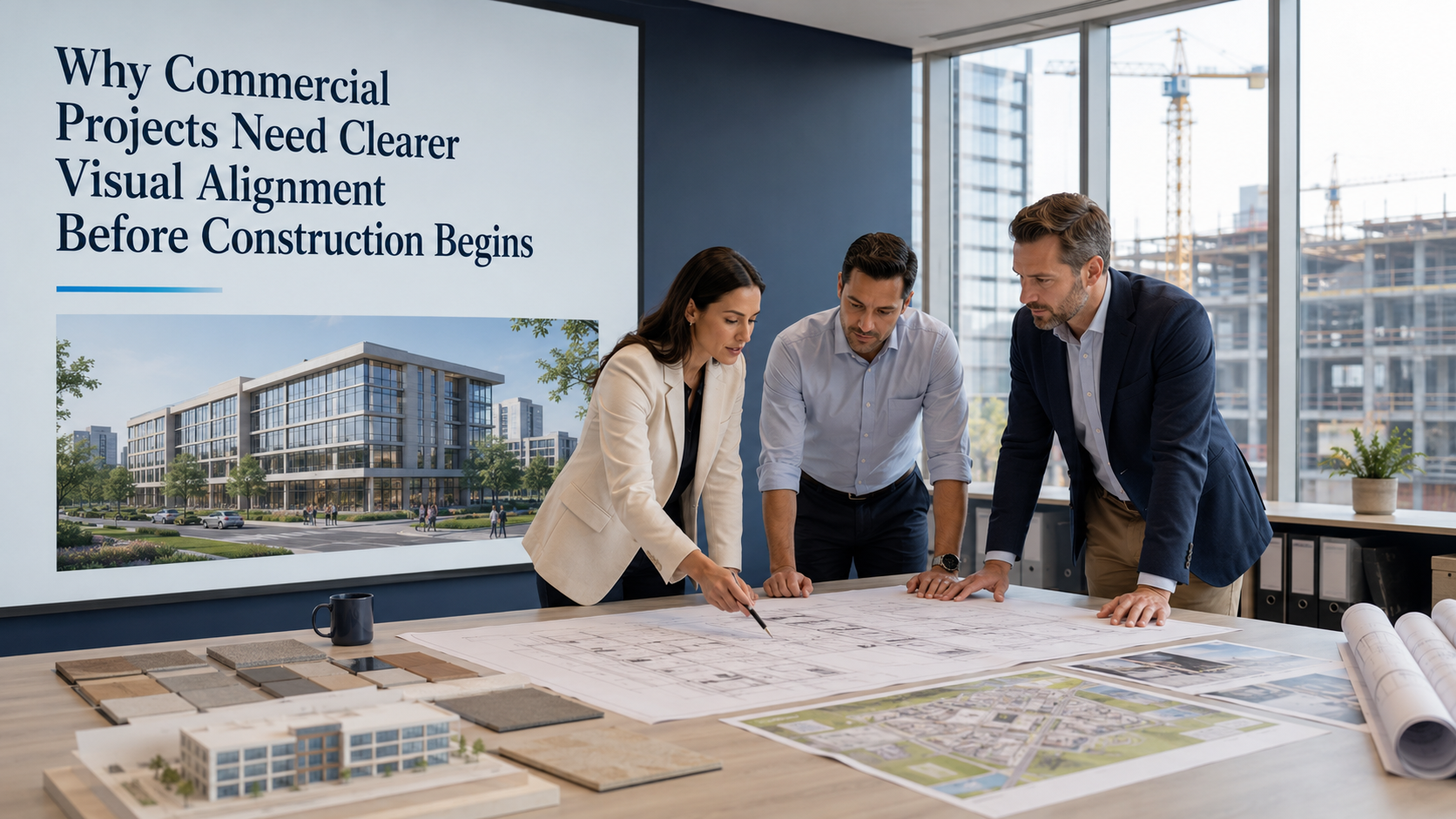
Commercial projects don't usually fail because of one dramatic mistake. They accumulate small misalignments — each one manageable on its own — until the combination becomes a problem that the project can't absorb without cost and delay.
Here's a fairly typical sequence: the owner has spent months thinking about a particular lobby experience. The contractor hasn't been told what that means in finish terms. The architect's drawings are technically complete but don't specify the elements that would actually produce what the owner is imagining. The tenant's team assumed a ceiling height that nobody corrected. The operator has a service routing requirement that didn't make it into the circulation plan. None of these people made an error. They were just never genuinely in the same conversation about the same building.
Why Commercial Projects Have a Communication Problem That Residential Doesn't
A house has maybe two or three decision-makers. A commercial project can have ten or fifteen — and they're not all trying to answer the same question.
The development team is thinking about asset value and return on investment. Somewhere else in the same project, the facilities manager is already thinking about maintenance access in fifteen years. The tenant's team cares about how staff will actually move through the space during a busy Tuesday. The brand or hospitality team is thinking about what a guest feels walking through the entrance for the first time. The contractor is thinking about whether the detail on the lobby feature wall is going to require a specialist subcontractor and what that does to the programme.
Technical drawings hold all of this together legally and contractually. They're also not always the most intuitive way for all of these people to understand the same building. A floor plan that shows a circulation route doesn't necessarily tell an operator whether that route will work for their service model. An elevation that shows an exterior treatment doesn't always convey whether the material specified will produce the impression the owner expects.
When owners, tenants, investors, contractors, and design teams need to evaluate a commercial project before construction begins, 3D rendering servicescan help clarify design intent, material choices, scale, circulation, and the relationship between interior and exterior spaces — making the design legible to the full range of people who need to act on it.
Scope Disputes Usually Start as Communication Failures
The $200,000 gap in expectations around lobby finishes doesn't come from dishonesty on either side. It comes from a concept that was described rather than shown.
"Premium finishes" means something different to a contractor pricing the job than to an owner who's been to a particular hotel in Singapore and is carrying a specific image in their head. When the conversation that should clarify this doesn't happen before the contract is signed, it happens later — in a much less comfortable setting.
The same problem appears with lighting, with material expression, with the quality of public-area design. These things are subjective until there's a reference point. Getting to a shared reference point before the construction documents are finalised is faster and cheaper than negotiating the gap afterward.
Hospitality Projects: Where Ambiguity Has Immediate Revenue Consequences
Hotels and restaurants expose the cost of misalignment more clearly than most commercial building types, because the building's performance is directly observable. If the entrance doesn't create the right first impression, review scores will say so. If the circulation doesn't support service efficiency, staff will feel it every shift.
When a hotel developer, a brand team, an architect, and an operator are all responding to the same rendered version of a lobby — rather than each interpreting a set of plans through their own frame — the conversations become more productive. Someone can point at a specific thing. "That lighting level doesn't work for check-in at 11pm." "The route from reception to the restaurant doesn't read clearly to guests." These are specific, actionable comments. They're much harder to generate from a floor plan alone.
Office and Retail: Operational Logic Gets Missed
A floor plan can be technically correct and still fail operationally. In office design, this usually shows up in how people actually move between zones — the acoustic relationship between collaboration spaces and focused work areas, whether the meeting rooms are accessible from the parts of the floor that use them most, how a visitor navigates from reception to a meeting without staff intervention.
In retail, the distance between back-of-house and the service counter matters for the daily rhythm of restocking. Customer pathing from the entrance determines what gets seen and in what sequence. These things are visible in the plan if you know what to look for. For the business operations team that isn't trained in plan reading, they may not become visible until the store is open.
Complexity in Current Commercial Projects Makes This Harder
Net-zero targets, smart building systems, wellness design standards, adaptive reuse of existing buildings, mixed-use programmes, modular construction: the list of things that have to be coordinated in a contemporary commercial project is longer than it was ten years ago, and the relationships between them are more complicated.
A building integrating occupant health monitoring with building management systems and renewable energy infrastructure requires design, technology, sustainability, and operations teams to coordinate from an early stage. When any of those teams is working from a different understanding of the finished building, the gaps compound rather than resolve.
Visuals Don't Replace Technical Process
Worth being clear about this, because it's easy to overstate.
Drawings, specifications, code compliance, MEP coordination, structural engineering, cost planning, and contracts are not optional. Visual tools work best when they're clarifying the decisions that technical documentation encodes — not substituting for the professional process that produces and validates that documentation.
A well-rendered project with inadequate specifications is still an inadequately specified project. The risk reduction comes from the whole process working well together.
When Assumptions Get Expensive
Change orders and RFIs are where unresolved design questions show up during construction — billed at construction rates rather than design rates. Some are unavoidable. Site conditions, unforeseen structural discoveries, and regulatory changes produce legitimate change orders regardless of how well the project was planned.
A meaningful number of them trace back to a question that could have been answered in a design review meeting if the stakeholders had been looking at the same thing. "We didn't realise the lobby ceiling height was that low" is a conversation that's free to have in a design review. During construction, it's a programme and cost problem.
What Should Be Confirmed Before Construction Starts
A reasonable pre-construction alignment check for any commercial project:
Does the owner understand the exterior character from more than the floor plan alone? Are material expectations tied to a specific reference rather than a general description? Have circulation and service routes been walked through by the parties who will actually use them? Are tenant or operator requirements documented and visible in the design? Has lighting and atmosphere been discussed rather than assumed? Are sustainability or smart-building features explained to everyone who will operate them? Are the drawings, specifications, visual references, and cost assumptions telling the same story?
Where any of these is uncertain, the project carries risk that is still relatively cheap to address. Construction makes it considerably less cheap.
Jump to
Why Commercial Projects Have a Communication Problem That Residential Doesn't
Scope Disputes Usually Start as Communication Failures
Hospitality Projects: Where Ambiguity Has Immediate Revenue Consequences
Office and Retail: Operational Logic Gets Missed
Complexity in Current Commercial Projects Makes This Harder
Visuals Don't Replace Technical Process
When Assumptions Get Expensive
What Should Be Confirmed Before Construction Starts

George Evans
Author
George Anderson, an exceptional architectural designer, envisions and brings to life structures that transcend the realm of imagination. With an unwavering passion for design and an innate eye for detail, George seamlessly blends form and function, creating immersive spaces that inspire awe.
Driven by a deep appreciation for the interplay of space, light, and materials, George's innovative approach redefines the possibilities of architectural design. His visionary compositions leave an indelible mark, evoking a sense of wonder and transforming the built environment.
George Anderson's transformative designs and unwavering dedication continue to shape the architectural landscape, pushing the boundaries of what is possible and inspiring generations to come.
Latest Articles
Popular Articles