NRC Vs STC For Interior Walls Simple Guide - Fix The Right Sound Problem
NRC vs STC for interior walls simple guide: learn echo vs privacy, why you can’t convert ratings, and what to prioritize for real results.
Author:George EvansAug 24, 202625 Shares24.9K Views
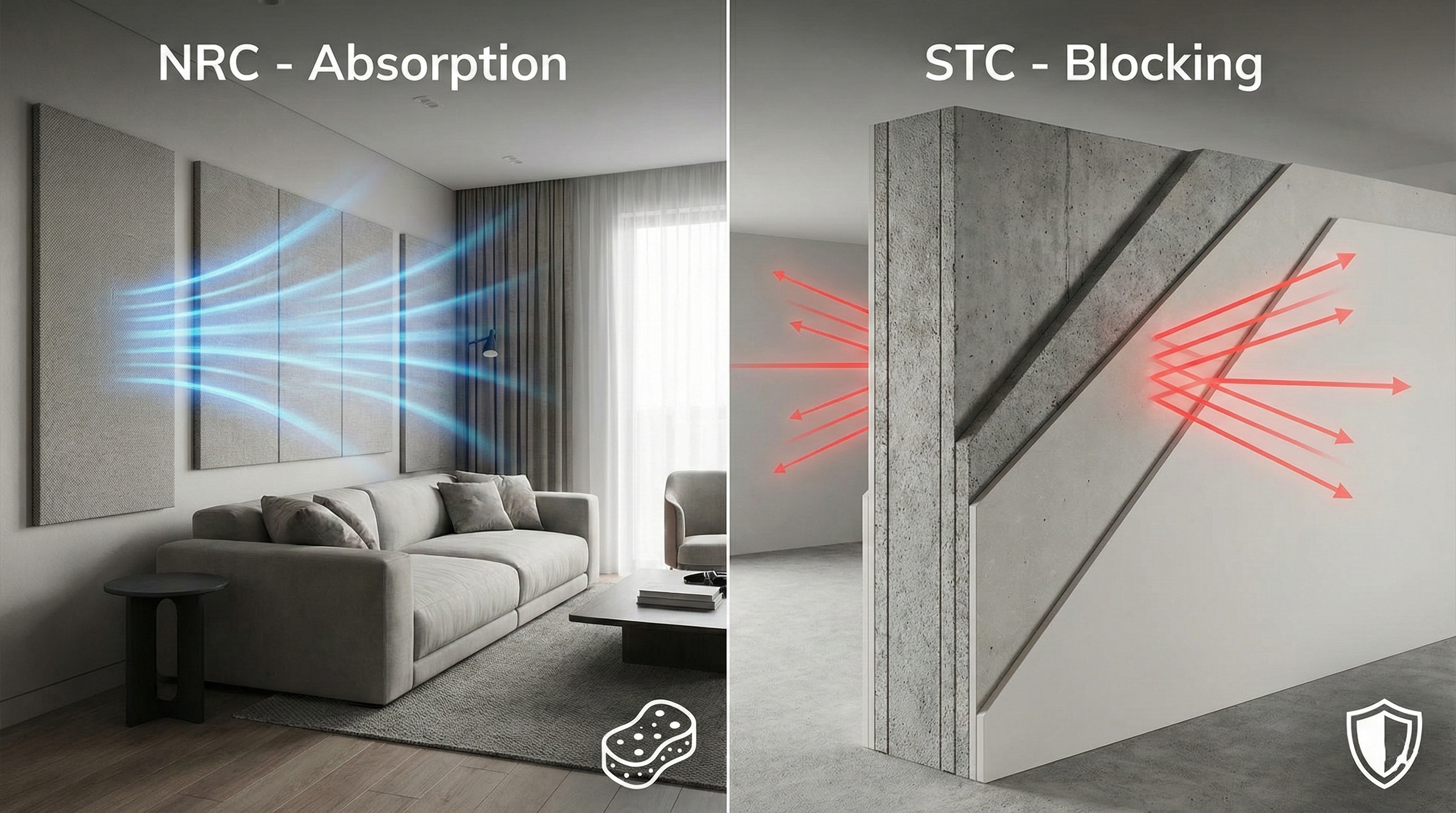
The Sponge Or The Shield? An NRC Vs. STC For Interior Walls Simple Guide
If you’ve ever bought acoustic panels to stop voices coming through a wall only to realize you can still hear every sentence, you’ve run into the most common acoustics mistake: solving the wrong problem with the wrong rating.
Interior-wall sound control is really two different jobs. One is making a room feel calmer less echo. The other is making two rooms feel more private, with less transmission. NRC and STC are not competing scores; they’re tools for different jobs.
Key Takeaways For Acoustic Planning
- NRC (Noise Reduction Coefficient): Measures sound absorption (range 0–1.0). Use this to stop echoes and hollow sounds inside a room.
- STC (Sound Transmission Class):Measures sound blocking (range 20–60+). Use this to keep noise from traveling through walls.
- The Golden Rule:Soft, porous materials (foam, carpet) have high NRC. Heavy, dense materials (drywall, concrete) have high STC.
The Quick Diagnosis: Do You Need Absorption Or Blocking?
Before buying materials, you must diagnose the noise disease your room is suffering from. If you apply a shield when you need a sponge, you will waste money and remain frustrated.
NRC: The Echo Test
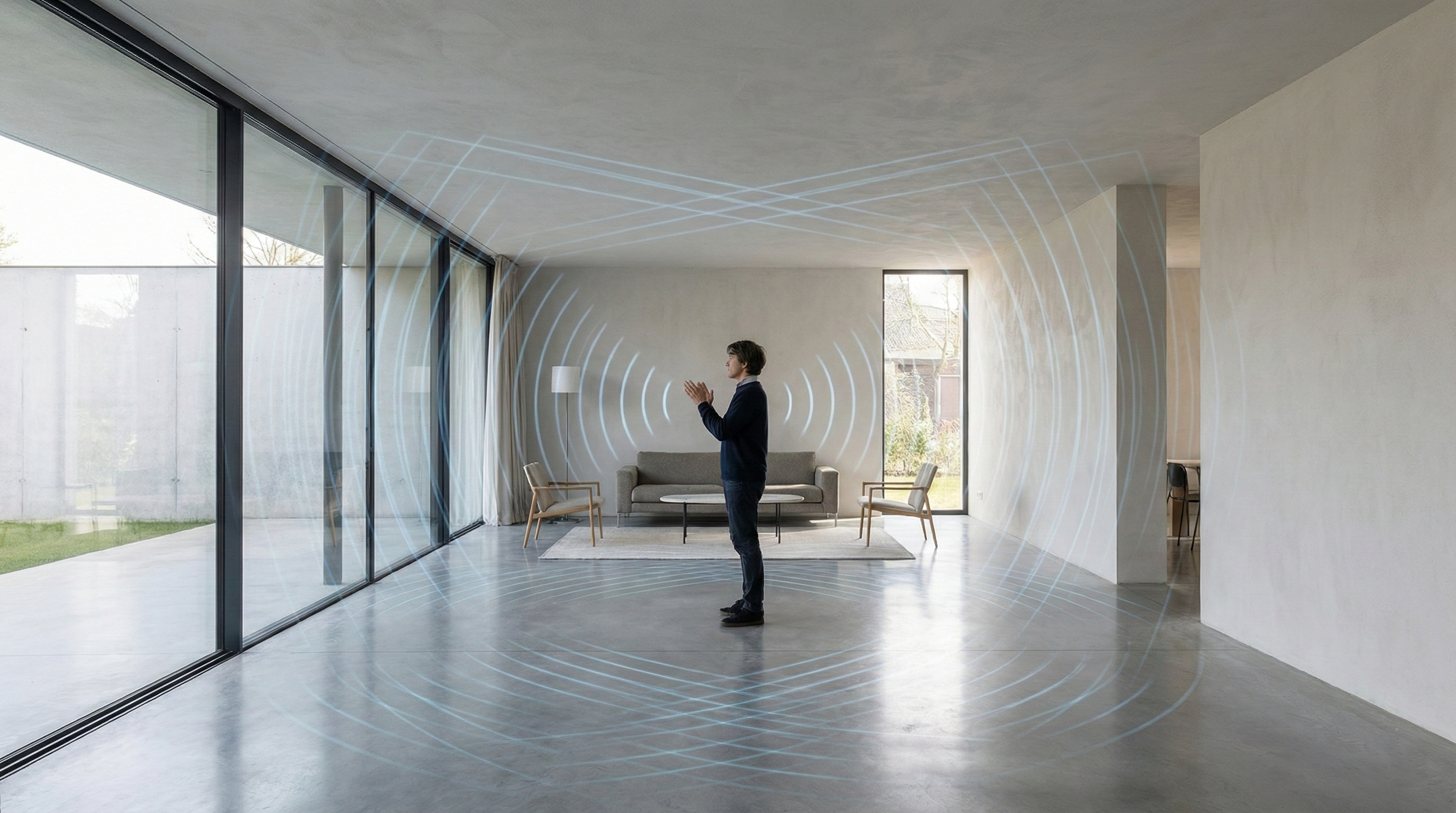
Imagine a minimalist modern living room with hardwood floors and glass walls. When you clap your hands, the sound rings or lingers.
This is a reflection problem. You need a high NRC (Noise Reduction Coefficient) to soak up those reflections so the room sounds warm and clear rather than harsh and bright.
STC: The Privacy Test
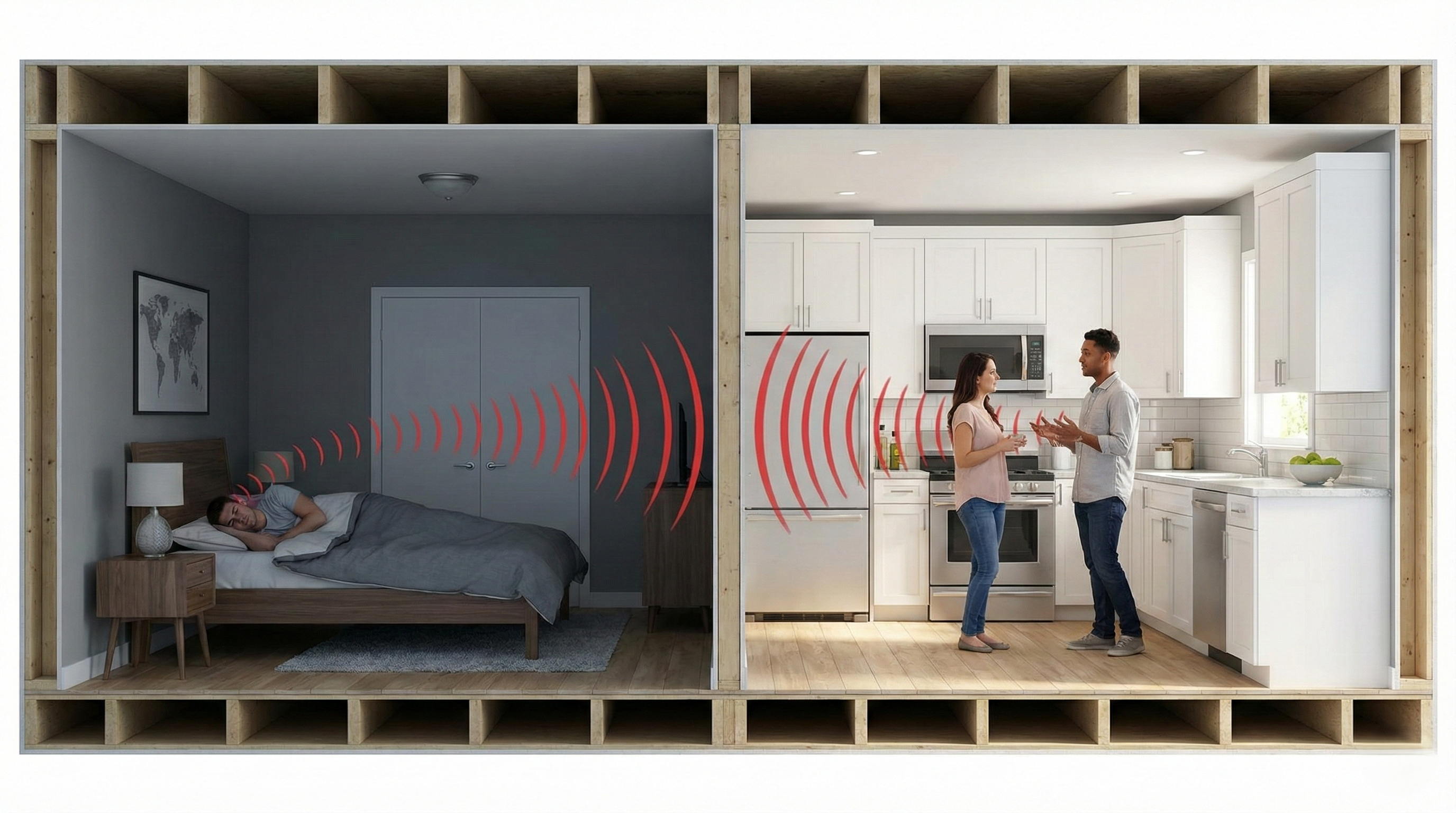
Now, imagine you are in a bedroom, and you can clearly hear the conversation happening in the kitchen next door.
The sound is traveling through the partition. This is a transmission problem. No amount of soft foam on the walls will stop that sound; you need a high STC Sound Transmission Class to act as a barrier.
Takeaway: If the sound is bouncing, look for NRC. If the sound is leaking, look for STC.
NRC In Plain English: What It Tells You
You’ll learn what NRC actually represents, when it’s the right spec, and why it won’t deliver soundproofing.
What NRC Measures
NRC is a shorthand for how absorptive a surface is in a room. Materials with higher absorptionreduce the amount of sound energy bouncing around, which can improve:
- Comfort in open offices
- Speech clarity in meeting rooms
- fatigue in restaurants and corridors
Absorption data comes from reverberation-room testing that produces sound absorption coefficients, the underlying measurements used to compare absorptive performance.
A simple mental model: NRC helps with what happens after sound is already in the room.
Why High NRC Won’t Stop Neighbor Noise
Absorption doesn’t create a barrier. A thick acoustic panel might make your room feel less lively, but sound can still pass through the wall because transmission is driven by things like:
- airtightness
- massive heavier layers
- vibration pathways through framing
So if your goal is privacy through an interior wall, NRC is usually a secondary priority.
When NRC Is The Primary Spec
Illustrative scenario: a design team finishes a glass-heavy conference room. The wall between the room and the hallway is solid, but the room still feels stressful because every word bounces.
Here, adding absorption high-NRC surfaces meaningfully changes the experience even if the wall’s STC never changes.
Takeaway:NRC is the right dial for echo control, but privacy problems require a different tool, STC.
STC In Plain English: What It Tells You
You’ll understand what STC represents, why it’s used for interior-wall privacy, and why it’s not the whole story.
What STC Measures
STC is a single-number rating derived from laboratory measurement of airborne sound transmissionloss through partitions and elements.
The rating method used to compare partitions and to calculate STC is defined in ASTM’s classification framework.
A simple mental model: STC helps with how much airborne sound gets from Room A to Room B through the assembly.
Why STC Is Speech-Focused
Because STC is a single-number summary derived from transmission data across a frequency range, not a guarantee for every sound type, two walls with the same STC can feel different:
- music with strong low frequencies
- subwoofers
- mechanical hum
In practice, low-frequency control tends to demand more attention to mass, decoupling, and airtightness, plus managing flanking paths.
Where STC Shows Up In Codes/Standards
If you’re dealing with dwelling-to-dwelling separations, the International Building Code includes a clear baseline: partitions separating dwelling and sleeping units must meet STC 50 lab, ASTM E90, or NNIC 45 field, ASTM E336 as an alternative.
Takeaway: STC is the core rating for interior-wall privacy, but you’ll get better outcomes when you combine STC thinking with real-world detailing and expectations.
NRC Vs. STC: The Ultimate Comparison
To select the right materials for your project, you must first understand whether you are fighting echo or transmission.
This breakdown expands on the technical differences between the Sponge (NRC) and the Shield (STC) to help you identify which metric matters most for your specific noise problem.
Feature
NRC: Noise Reduction Coefficient
The NRC is a scalar representation of how much sound energy a surface can absorb. It specifically measures the efficiency of a material in reducing sound reflections within a room.
Think of it as a measure of acoustic internal comfort. It tells you how much sound will stay in the room versus how much will be neutralized upon impact with the walls or ceiling.
STC: Sound Transmission Class
The STC is an integer rating that indicates how much airborne sound a partition (like a wall or ceiling) blocks.
It measures the effectiveness of a barrier in preventing sound from passing from one side to the other. In architectural design, this is our primary tool for acoustic privacy.
It tells you how much sound is successfully deflected or stopped by the mass of the structure.
Primary Goal
NRC: Stop Sound From Reflecting
The goal of NRC-rated materials is to eliminate flutter echo and reverberation. By soaking up sound waves, these materials improve the acoustic clarity inside the space where the noise is generated.
This is essential for environments where speech intelligibility is key, such as classrooms or recording studios, where you don't want your last word smearing into your next one because of reflections.
STC: Stop Sound From Traveling
The goal of STC-rated materials is to ensure privacy and isolation. These materials act as a shield, preventing noise from leaking through the wall and disturbing people in the adjacent room.
The focus here is not on how the room sounds, but on how much noise it contains. This is why a heavy concrete wall has a high STC but a very low NRC; it stops the sound from leaving, but causes it to bounce around harshly inside.
Ideal Range
NRC: 0.0 To 1.0
NRC is measured on a scale where 0.0 is perfectly reflective, like a mirror or polished marble, and 1.0 is perfectly absorptive, like an open window where sound never returns.
Most high-quality acoustic panels fall between 0.75 and 0.95. Occasionally, you may see ratings like 1.05; this isn't a math error, but a result of the material's three-dimensional surface area absorbing more sound than its flat footprint would suggest.
STC: 25 To 65+
STC is measured in decibels on a logarithmic scale. A standard 2x4 stud wall with 1/2 drywall on both sides is usually around STC 33, which is quite poor for privacy.
A high-performance soundproof wall typically aims for STC 50 or higher. At STC 50, loud speech becomes a faint murmur, and at STC 60, most airborne noises, like a loud TV, are effectively eliminated for the neighbor.
Material Feel
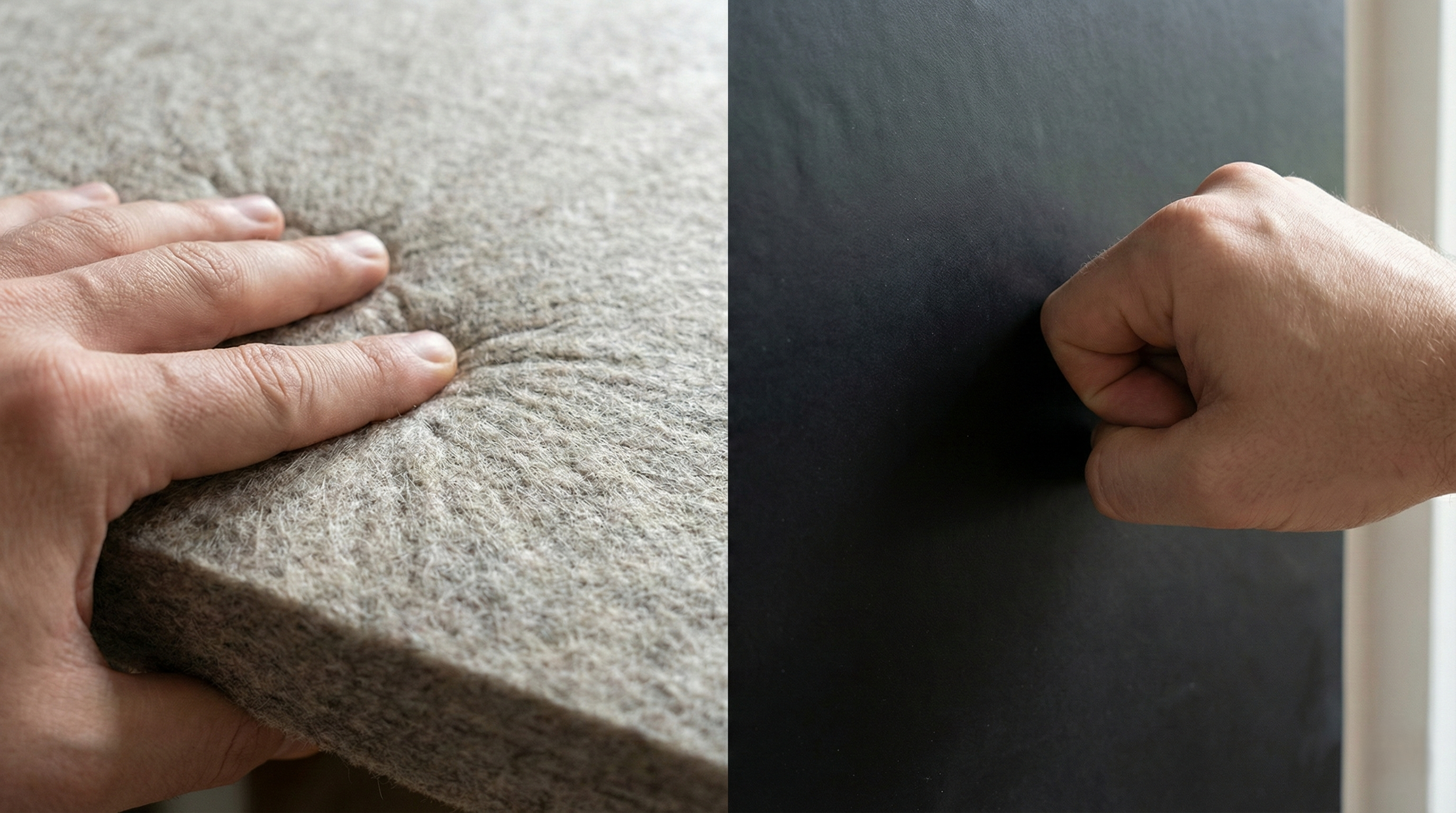
NRC: Soft, Porous, And Lightweight
High-NRC materials are almost always fuzzy, open-celled, or fibrous. They need to be porous, so sound waves can enter the material's microscopic labyrinth and be converted into tiny amounts of heat energy through friction.
If you touch an NRC material, it usually feels soft to the touch, like felt, foam, or a heavy wool blanket.
STC: Heavy, Dense, And Airtight
High-STC materials require mass and rigidity. To block sound waves, a material needs to be heavy enough to resist vibrating.
If a material is light and breathable, sound will pass through it easily. This is why soundproofing requires heavy hitters like lead-lined sheets, thick masonry, or specialized high-density drywall that is significantly heavier than the standard variety.
Common Materials
NRC: Foam, Fabric, And Fiberglass
You will find high NRC ratings in acoustic foam wedges, heavy velvet curtains, thick carpets, and specialized fiberglass or mineral wool ceiling tiles.
These materials are often used as finish materials, meaning they are the last layer you see on the wall because their job is to interact directly with the air in the room.
STC: Drywall, Concrete, And Lead
High STC ratings are achieved using multiple layers of 5/8 drywall, Mass Loaded Vinyl (MLV), solid concrete blocks, or specialized Sound-Deadening boards like QuietRock.
These are structural materials. They are often hidden behind the finish layer or built into the skeleton of the wall to provide the necessary weight and airtight seal to stop sound dead in its tracks.
Best For
NRC: Home Studios And Offices
NRC is the priority when you need to improve the quality of a recording or make a large, boomy office feel quieter and more professional.
It fixes the clatter of a busy restaurant or the hollow sound of a video call. If your voice sounds like you're in a bathroom, you need more NRC.
STC: Bedrooms And Shared Walls
STC is the priority when you want to sleep without hearing your neighbor’s TV or when you need to ensure that private conversations in a boardroom stay private.
It is the metric for neighbor peace. If you can hear exactly what the person in the next room is saying, you have an STC problem.
What It Measures
Surface Absorption & Reflection Control
NRC measures the average sound absorption across four specific octave bands: 250, 500, 1000, and 2000 Hz.
These frequencies represent the meat of the human vocal range. By calculating the arithmetic mean of these coefficients, the rating tells you how much energy dies when it hits the surface.
It is essentially a measure of acoustic hospitality how comfortable it feels to speak and listen in that room without the sound bouncing back and muddying the conversation.
Airborne Noise Attenuation & Transmission Loss
STC measures the total decibel reduction of airborne sound across a broader spectrum of 16 standard frequencies ranging from 125 to 4000 Hz.
Unlike NRC, which looks at what happens at the surface, STC looks at what happens through the entire assembly.
It accounts for how a wall’s mass, stiffness, and internal damping work together to stop sound pressure from vibrating the structure and radiating noise into the next room. It is the primary metric for privacy and isolation.
Testing Method
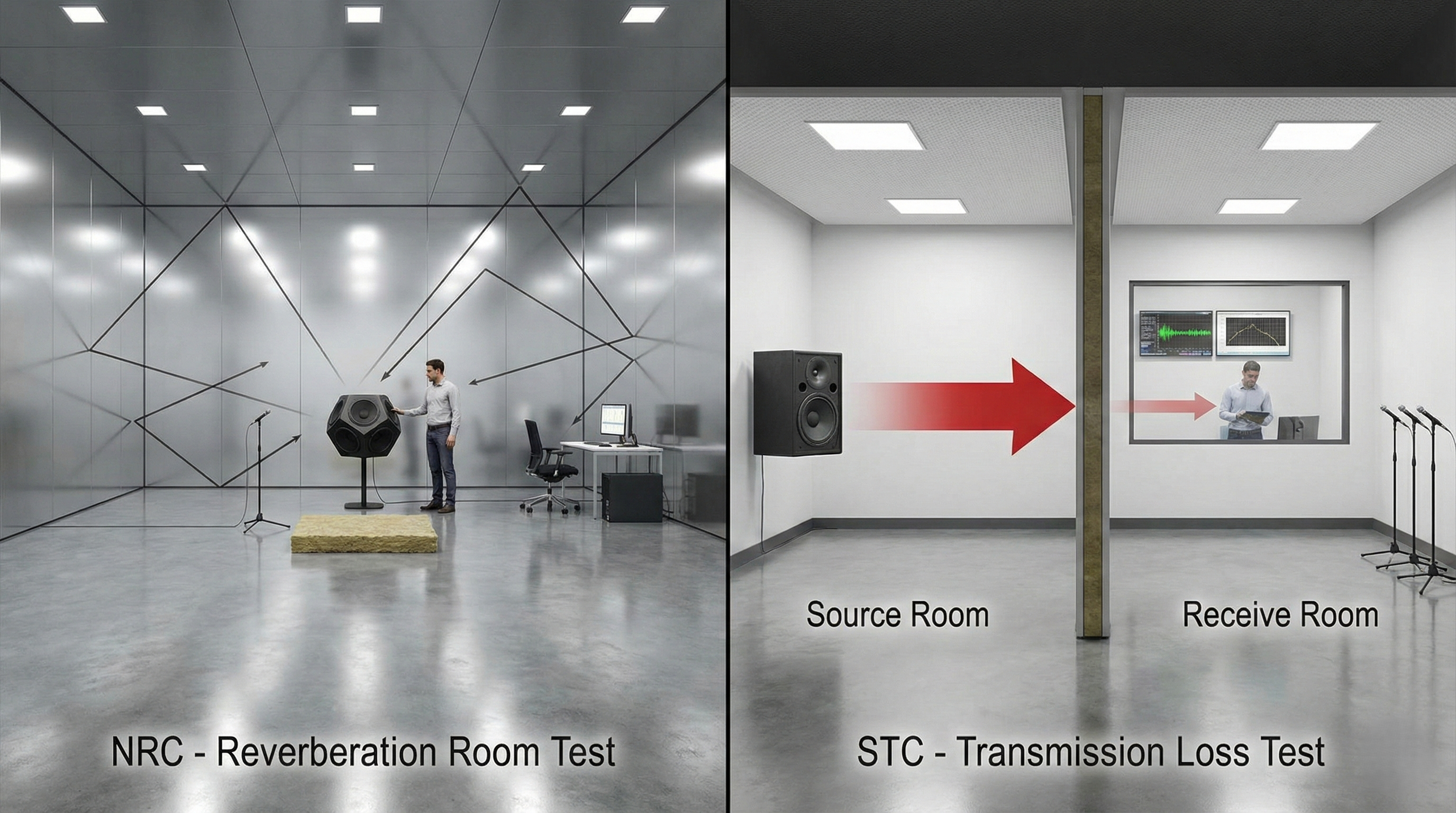
Reverberation Room Test (Astm C423)
To determine an NRC rating, laboratories use the ASTM C423 standard. A large sample of the material is placed inside a reverberation chamber, a room designed to be as reflective as possible.
Technicians measure the RT60 (the time it takes for a sound to decay by 60 decibels) both with and without the material present. The difference in decay time allows them to calculate the precise absorption coefficient.
Because of the way sound edges interact with the sample, you will sometimes see ratings above 1.0, which indicates extreme efficiency.
Transmission Loss Test (Astm E90)
The STC rating is derived using the ASTM E90 standardin a dual-room laboratory setup. A Source Room and a Receive Room are completely decoupled so that the only path for sound to travel is through the test wall partition built between them.
A loud, full-spectrum pink noise is generated in the source room, and sensitive microphones measure the sound levels on both sides.
The resulting transmission loss data is then plotted against a standard STC contour curve to determine the final single-number rating.
Limitations
The Bass Gap And Low-Frequency Failure
The most significant limitation of NRC is that it completely ignores frequencies below 250 Hz.
In a home theater environment, a foam panel may boast an NRC of 0.90, giving the illusion of total control, while the thump of the subwoofer (60–120 Hz) passes through the panel as if it weren't there.
For low-end energy, NRC is largely irrelevant; you instead need bass traps, which rely on thickness and air gaps rather than just surface texture to manage long, powerful sound waves.
The Weakest Link And Flanking Paths
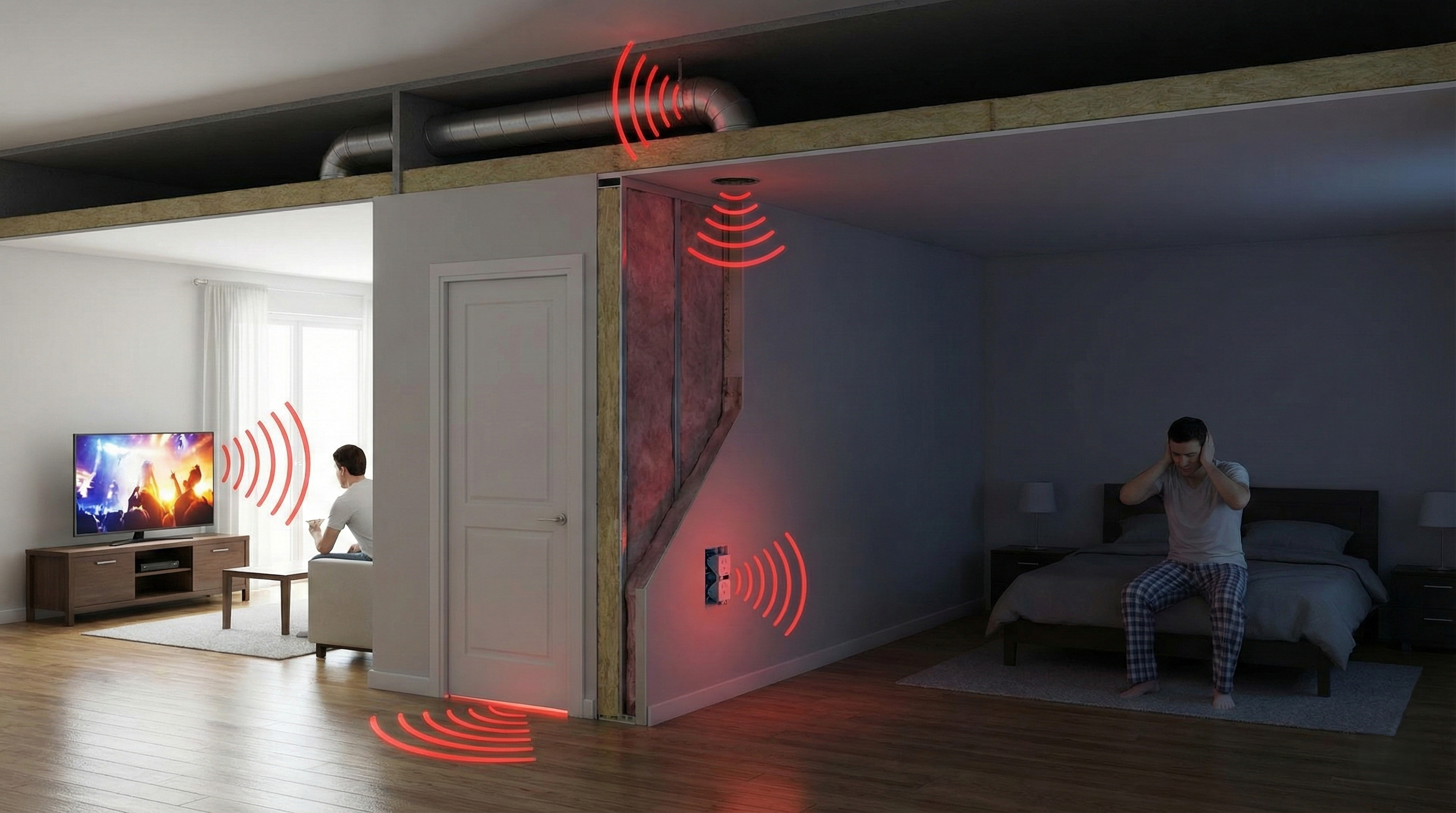
An STC rating is a laboratory measurement of a perfect, airtight partition, something that rarely exists in a real home.
A wall rated at STC 55 can be effectively downgraded to an STC 30 by a single flanking path, such as an unsealed gap under a door, a shared HVAC duct, or back-to-back electrical boxes.
Furthermore, STC does not measure structure-borne noise, such as footsteps, Impact Insulation Class or IIC, or the vibration of a washing machine, meaning a high STC wall won't stop the ceiling from shaking when someone walks upstairs.
How To Raise STC On An Interior Wall
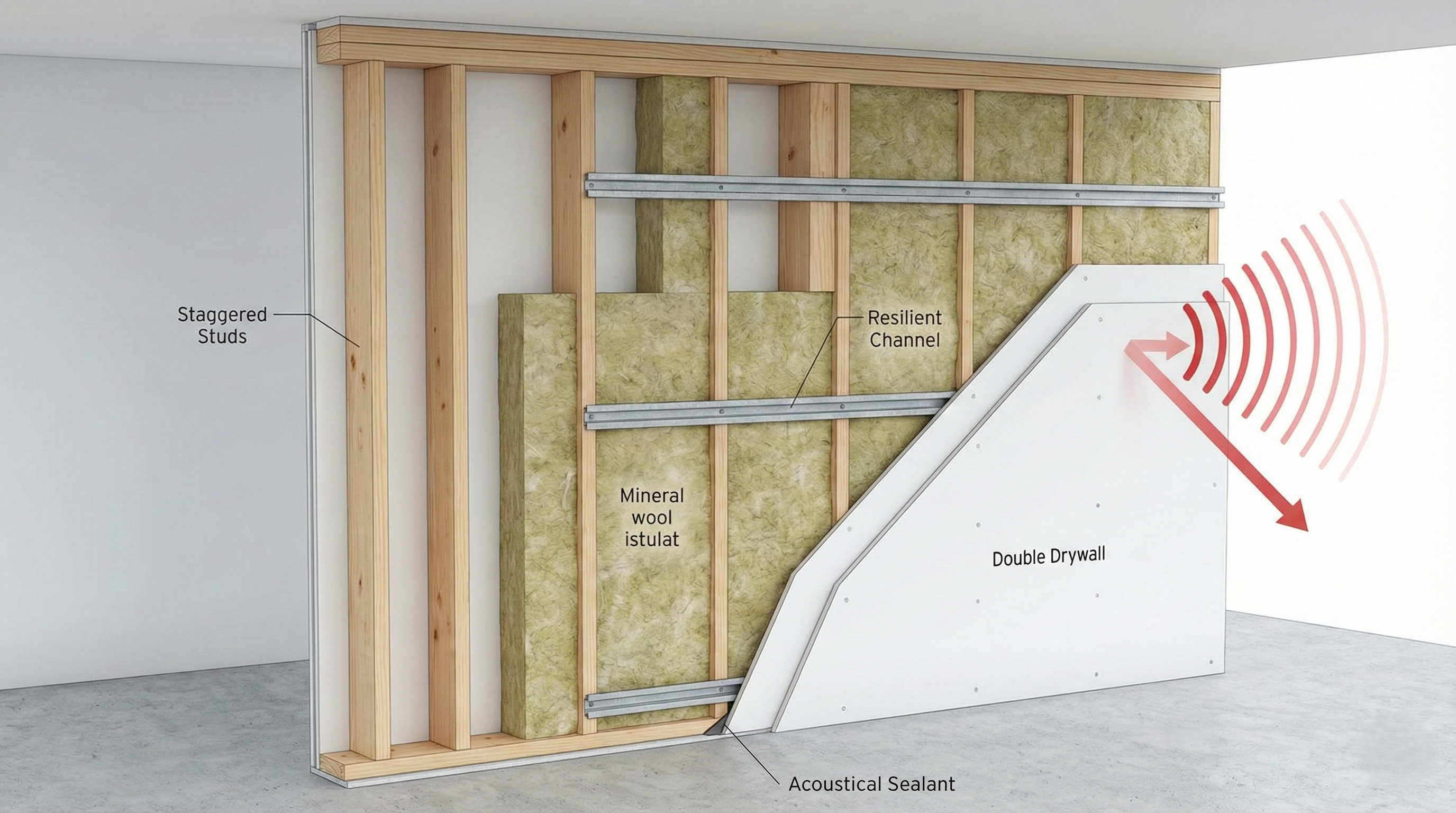
You’ll learn the sequence that tends to work best so you don’t add expensive layers and still lose to a 1/8-inch gap.
Step 1: Airtightness: Seal Gaps, Perimeters, And Penetrations
Airborne sound behaves like air: if air can move through, sound can move through. Start with:
- continuous perimeter sealing top, bottom, sides
- acoustical sealant at seams and junctions
- careful treatment of outlets, pipes, and back-to-back boxes
Step 2: Cavity Absorption
Cavity insulation can improve performance by calming resonances inside the stud bay, but it won’t compensate for:
- leaks
- rigid vibration paths
- flanking through adjacent assemblies
Step 3: Add Mass
More mass generally improves resistance to airborne transmission. Practical moves include additional gypsum layers or heavier assemblies done with attention to seams and airtightness.
Step 4: Decouple
Decoupling strategies reduce the mechanical path that carries sound:
- resilient channels
- isolation clips and hat channel
- staggered stud or double stud assemblies (space-dependent)
ASTM’s rating framework explicitly acknowledges that real buildings can rate lower than labs due to flanking transmission and construction errors, which is exactly why decoupling and detailing matter.
Mini Leak Audit Checklist
Checklist
- Do you see light through any door or perimeter gaps?
- Are outlets back-to-back on the shared wall?
- Are there unsealed penetrations, pipes, cables, or HVAC?
- Is the wall continuous to the deck/structure, or does a ceiling plenum bypass it?
- Is there a duct or return path connecting rooms?
Expert’s Take
I treat sound privacy like waterproofing: tiny discontinuities dominate. Before changing the wall assembly, I look for every place sound can leak around it.
Takeaway: Once the wall stops leaking and vibrating as a single rigid plate, it’s time to make the room itself feel better, with NRC serving as the smart dial.
How To Raise NRC In A Room
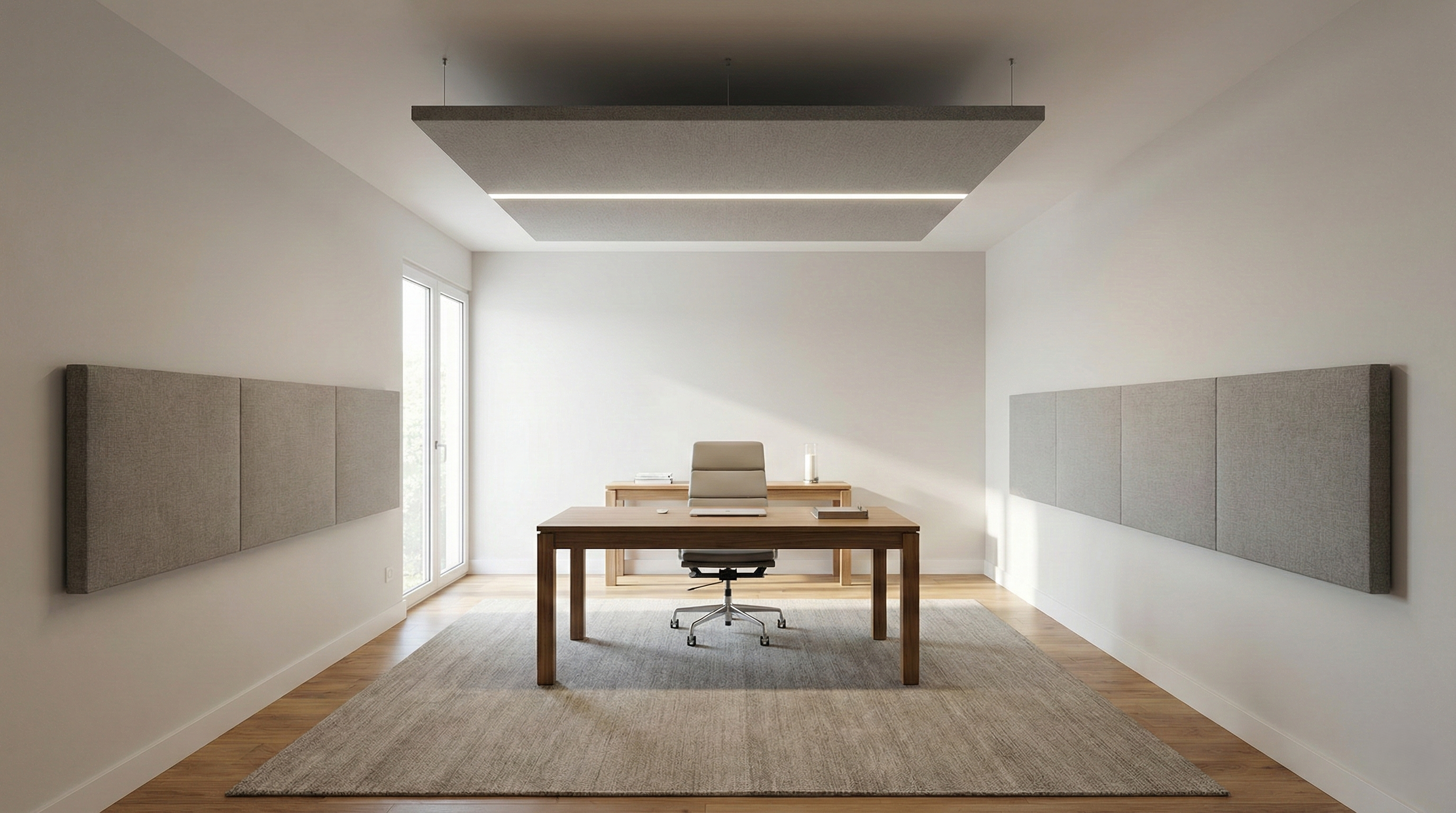
You’ll learn where absorption actually moves the needle and how to keep it design-friendly.
Where Absorption Helps Most
Absorption does the most work when it interrupts large, reflective surfaces:
- Ceilings: the biggest uninterrupted plane in many rooms
- Flutter echo: opposing parallel walls
- first-reflection zones near talkers/listeners in meeting rooms
The underlying absorption measurements are based on standardized reverberation-room methods that quantify sound absorption coefficients.
The Design-Friendly Approach
Instead of random patches of foam, think in coverage zones:
- fabric-wrapped panels targeted placements
- acoustic ceiling systems
- baffles/clouds where ceiling reflection dominates
- rugs and soft furnishings when appropriate for the space
When To Stop
A room can become unnaturally dead if absorption is overdone, especially in spaces where some liveliness is desirable. The goal is comfort and clarity, not silence.
Takeaway: Many projects aren’t either/or, so next we’ll map a hybrid playbook that balances privacy and comfort.
When You Need Both: A Hybrid Interior-Wall Playbook
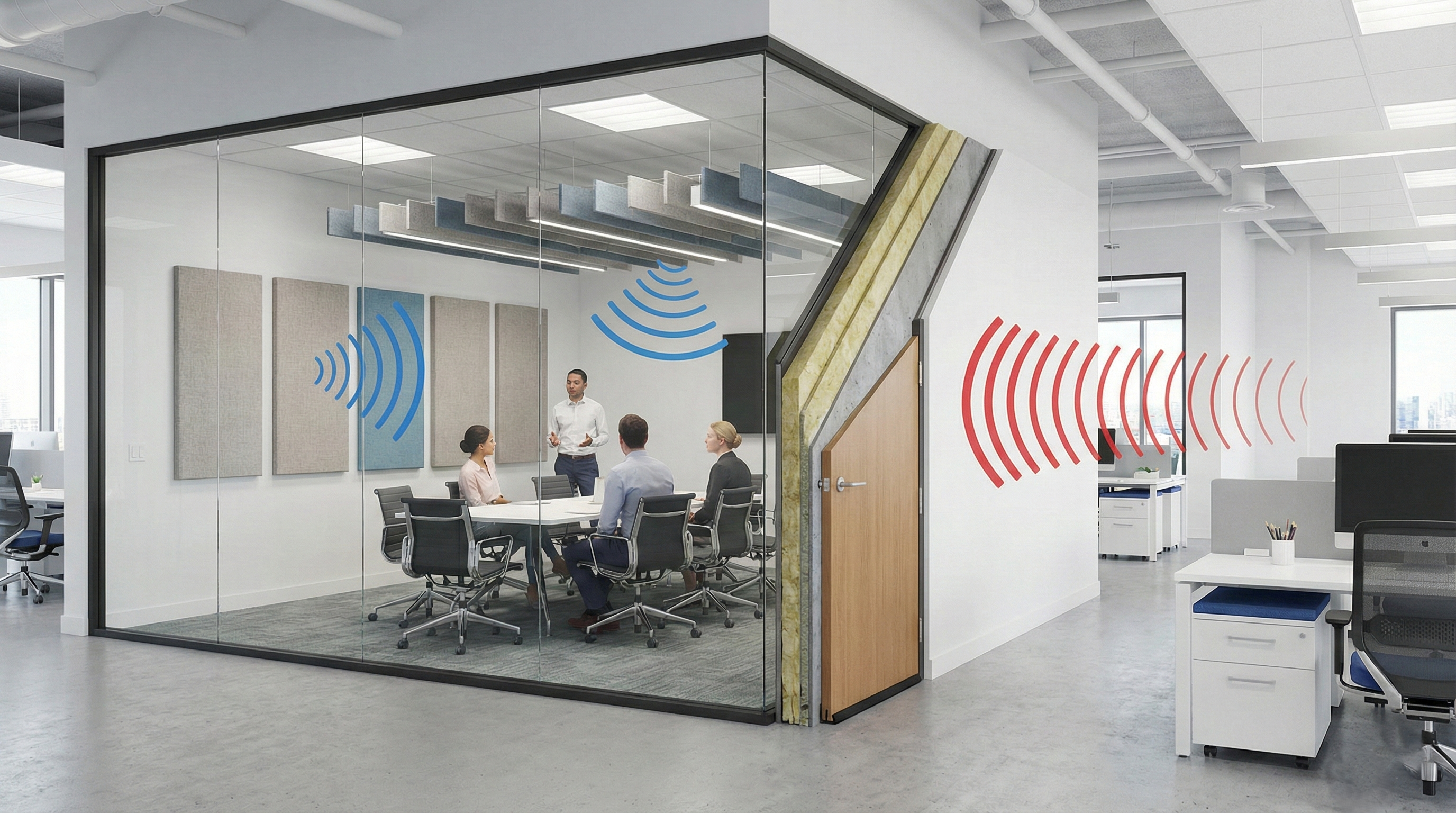
You’ll see how NRC and STC work together in realistic layouts so you can specify both without wasting money.
Scenario A: Conference Room Next To The Open Office
A team adds high-NRC panels inside the conference room to calm reflections. The room sounds better, but people outside still hear sensitive phrases. The fix is hybrid:
- STC-focused partition upgrades (seal + mass + decouple as needed)
- NRC inside the room for comfort and clarity
Scenario B: Bedroom Wall Shared With The Living Room
The bedroom needs privacy; the living room needs comfort. A hybrid approach often looks like:
- stronger interior wall assembly and airtightness for privacy
- absorption in the living room to reduce overall sound energy and perceived loudness
Scenario C: Multifamily Wall + Door Reality Check
A demising wall may meet a lab target, yet residents complain because:
- The corridor door leaks
- The ceiling plenum flanks the partition
- penetrations are unsealed
This is why field realities can undercut lab promises, something ASTM’s rating framework and the IBC’s field-test alternative both reflect.
Takeaway:The next step is avoiding spec confusion cause STC and NRC often show up beside other ratings that mean something else entirely.
How Ratings Are Tested
You’ll get the minimum test-method literacy needed to read specs intelligently without getting buried in acoustics textbooks.
NRC Testing Context
Absorption performance is measured using reverberation-room methods that define how absorption coefficients are determined in practice.
That’s the foundation for comparing how materials behave as absorbers in interior environments.
STC Testing Context
Laboratory airborne sound transmission loss is measured with ASTM E90 for partitions and elements such as walls and floor-ceiling assemblies.
The STC single-number rating is then derived using standardized classification methods, ASTM E413.
Flanking + Workmanship
ASTM explicitly notes that a partition tested in a building may rate lower than one tested in a lab due to flanking transmission or construction errors, which is the most honest explanation for why it doesn’t feel like the rating.
Takeaway: With the concepts and constraints clear, you can answer the most common questions quickly without falling back into rating confusion.
Why Your High Ratings Might Fail: The Flanking Path Problem
In architecture, we have a saying: A soundproof wall is only as good as its weakest link. You can build an STC 60 wall, but if you have a 1/4-inch gap under the door, your effective rating will drop to STC 30.
Air Leaks And The Swiss Cheese Wall
Sound behaves like water. If air can pass through, sound will pass through. Common leaks include:
- Electrical outlets back-to-back in the same wall.
- Gaps around window frames.
- Recessed can lighting in the ceiling.
The Role Of Doors And Windows
A standard hollow-core interior door has an STC of about 20. If you are serious about soundproofing a room, you must upgrade to a solid-core door and add a drop-seal at the bottom.
Takeaway: Before spending money on soundproofing panels, buy a $10 tube of acoustic caulk and seal every gap you can find.
George’s Pro Tip: The Egg Carton Myth
I often see DIYers stapling egg cartons to their walls. Let’s set the record straight: Egg cartons do nothing.
They are too thin to block sound (STC 0) and too hard to absorb it (NRC < 0.1). They are a fire hazard, not an acoustic solution. If you're on a budget, heavy moving blankets are a much better temporary fix.
Cost Vs. Effort Reality Check
Before you start, it is worth knowing the pain price of these two paths.
Fixing NRC (Echo):
- Effort:Low. You can hang panels like pictures or add heavy rugs.
- Cost:Low to Medium. You can buy effective panels for $50–$100 each or DIY them.
- Mess:Zero. No demolition required.
Fixing STC (Privacy):
- Effort:High. You usually need to add mass (another layer of drywall) or tear open the wall to add insulation and resilient channels.
- Cost:High. Requires construction materials, sealant, and repainting.
- Mess:High. Drywall dust and construction debris.
The Strategy:Always try the easy wins first. Seal the air gaps (STC) and add a rug (NRC). If that doesn't work, then prepare for the construction work required for a true STC upgrade.
Also Check Out: Laundry Room Layout Dimensions: Measure For A Real-World Fit
Frequently Asked Questions (FAQ)
What Is The Difference Between NRC And STC?
NRC reduces echo inside a room by absorbing reflections. STC reduces airborne sound through a wall between rooms for better speech privacy.
Which Matters More For Interior Walls, NRC Or STC?
If you want privacy, prioritize STC. If the room sounds harsh or echoey, prioritize NRC. Many spaces need both.
Can You Convert NRC Or STC?
Not directly. NRC measures absorption; STC measures transmission loss through an assembly. There are different tests for different acoustic problems.
Can Acoustic Panels Improve STC?
Mostly no. Panels absorb reflections (NRC). Sound leaking through walls usually needs airtightness, mass, and decoupling to raise STC.
What STC Rating Is Good For Apartments?
Many building codes reference a baseline around STC 50 lab or an NNIC 45 field alternative for certain dwelling separations verify local adoption.
How Do You Achieve An STC Rating Of 50?
Start with airtightness seal gaps, add cavity insulation, increase mass with additional layers, and decouple clips/channel to reduce vibration paths.
Why Can I Still Hear Noise Through A High STC Wall?
Flanking paths, doors, vents, outlets, ceilings, and gaps can bypass the wall. Construction details and leaks often dominate real-world performance.
What’s The Difference Between NIC/NNIC And STC?
STC is typically lab-based. NIC/NNIC are field-focused isolation ratings that reflect real building conditions, including flanking paths and workmanship variables.
What’s The Difference Between STC And IIC?
STC rates airborne sound transmission through assemblies. IIC rates impact/footfall sound through floor-ceiling assemblies.
Does Insulation Increase STC?
It often helps by reducing cavity resonance, but it won’t fix leaks or flanking. Think of insulation as support, not a standalone solution.
What Is The Nrc Rating Of Insulation?
Insulation can be absorptive when exposed, but inside a wall cavity, it’s mainly used to support overall assembly performance rather than to treat room echo.
What NRC Should I Aim For In A Room?
Aim higher NRC on major reflective surfaces when echo is the issue. The right level depends on room size, finishes, and whether the room is for speech or music.
Is STC Good For Bass/Music Noise?
STC correlates well with speech-range privacy, but doesn’t guarantee satisfaction for low-frequency bass. Bass usually demands more mass, airtightness, and decoupling.
What’s A Quick Way To Diagnose My Problem?
If the room sounds echoey, prioritize NRC. If you hear conversations through the wall, prioritize STC.
Do Doors Matter As Much As Walls For Sound?
Yes. Doors, gaps, and penetrations can undercut a high-STC wall. Sound control is only as strong as the weakest link.
Conclusion
True acoustic comfort requires a balance of both metrics. In a home office, you need a high-STC wall to block the sound of the kids playing in the hallway, but you also need high-NRC panels on the wall so your voice doesn't sound like you're speaking from inside a cave during Zoom calls.
Start by sealing the air leaks, then focus on adding mass (STC) for privacy, and finally add soft textures (NRC) for clarity. By treating your walls as both a sponge and a shield, you can transform any chaotic room into a sanctuary of focus.
Jump to
The Sponge Or The Shield? An NRC Vs. STC For Interior Walls Simple Guide
Key Takeaways For Acoustic Planning
The Quick Diagnosis: Do You Need Absorption Or Blocking?
NRC In Plain English: What It Tells You
STC In Plain English: What It Tells You
NRC Vs. STC: The Ultimate Comparison
How To Raise STC On An Interior Wall
How To Raise NRC In A Room
When You Need Both: A Hybrid Interior-Wall Playbook
How Ratings Are Tested
Why Your High Ratings Might Fail: The Flanking Path Problem
Frequently Asked Questions (FAQ)
Conclusion

George Evans
Author
George Anderson, an exceptional architectural designer, envisions and brings to life structures that transcend the realm of imagination. With an unwavering passion for design and an innate eye for detail, George seamlessly blends form and function, creating immersive spaces that inspire awe.
Driven by a deep appreciation for the interplay of space, light, and materials, George's innovative approach redefines the possibilities of architectural design. His visionary compositions leave an indelible mark, evoking a sense of wonder and transforming the built environment.
George Anderson's transformative designs and unwavering dedication continue to shape the architectural landscape, pushing the boundaries of what is possible and inspiring generations to come.
Latest Articles
Popular Articles